
Needing space in a relationship is normal, and it usually isn’t a sign that anything is wrong.
Healthy space is time to recharge, think your own thoughts and keep the parts of you that existed before the relationship.
Done well, it comes with a clear “I’ll be back” and makes your time together better.
Below are 15 practical ways to create it, how to ask without hurting your partner, and how to tell healthy space from avoidance.
Why space helps a relationship
Constant closeness sounds romantic, but real life gets tiring when you live together, work from home or text all day.
Without breathing room, small things start to feel big.
A harmless question irritates you.
A minor habit feels impossible to ignore.
Often you’re not angry at your partner; you’re simply overloaded.
There’s also a bigger reason.
Research summarized by the Gottman Institute suggests that around 69% of couple conflicts are “perpetual”, meaning they come from lasting differences in personality and preferences rather than one fixable issue.
Those differences don’t go away, so the goal is to handle them kindly.
A little space gives both of you time to cool down and return with more patience.

And space keeps things interesting.
In studies by psychologist Arthur Aron and colleagues, couples who did new, mildly exciting things together reported higher relationship quality.
Time apart gives each of you new experiences, ideas and energy to bring back.
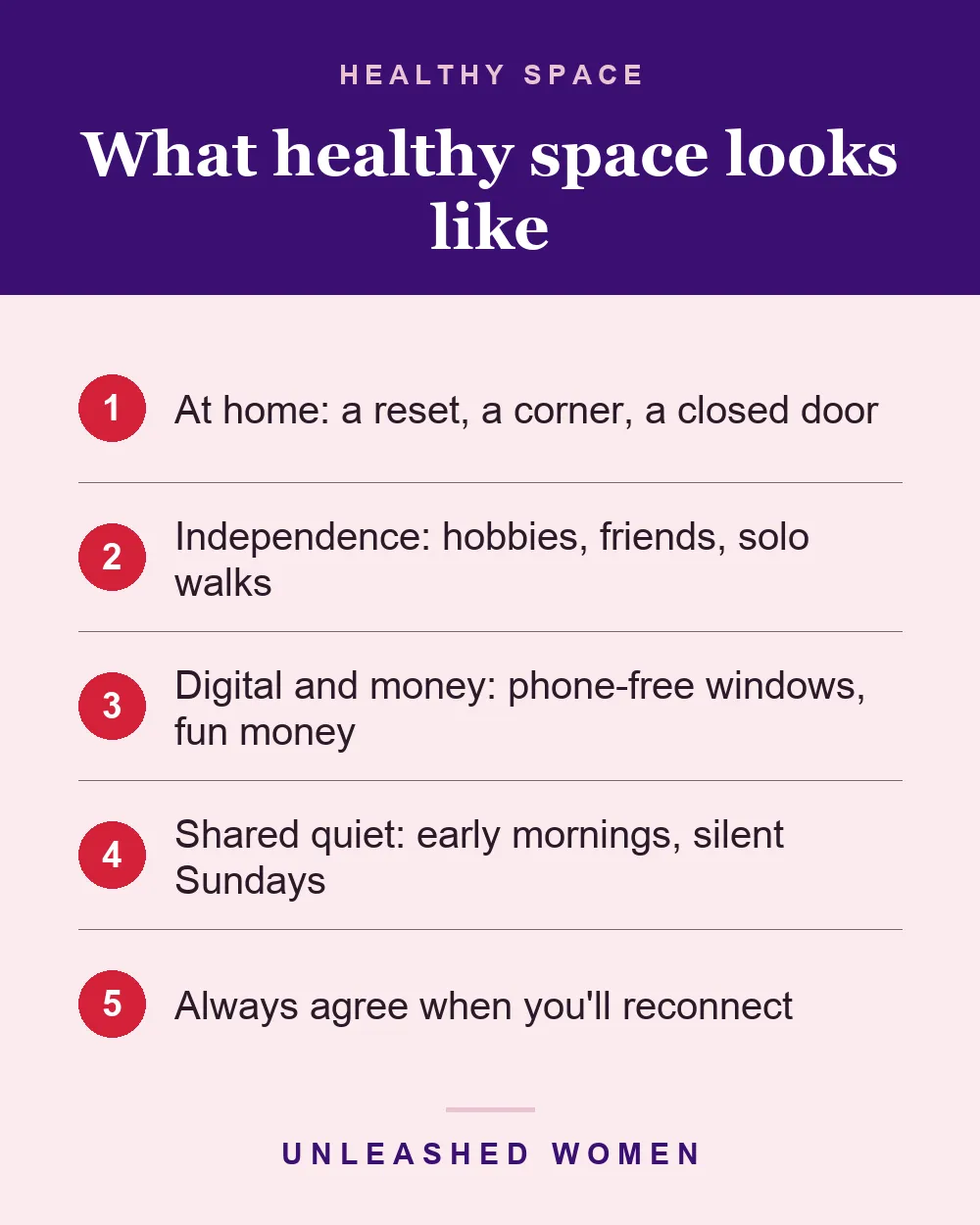
Space at home: 1 to 5
- Try a 20-minute reset after work. When you both get home, give each other a short buffer before diving into chores, plans or the day’s complaints. A few quiet minutes helps you shift out of work mode and lowers the odds of snapping at each other.
- Create a “sacred corner”. Even in a small apartment, one chair or desk can become a signal for “I’m off duty for a bit.” The furniture isn’t the point; the shared understanding is.
- Respect the closed-door rule. If a door is closed, knock. It sounds basic, but it quietly communicates respect for each other’s privacy, even when you’re very close.
- Use headphones as a friendly signal. Headphones say “I’m here, but in my own world for a while” without a tense conversation. Agree on the signal together so it never feels like a brush-off.
- Respect work hours at home. If you both work from home, treat each other like friendly coworkers during work time. Constant small interruptions wear down focus and patience.
Independence: 6 to 10
- Keep independent hobbies. Not every interest has to be shared. One of you paints, the other joins a running club, and you both have something to talk about later.
- Maintain separate friend time. You need people who know you as an individual, not only as half of a couple. The nonprofit love is respect gives “I need space to hang out with my friends and do things I enjoy on my own” as an example of a healthy boundary.
- Schedule solo walks. Twenty minutes outside on your own gives you movement, fresh air and mental distance without turning it into a relationship conversation.
- Do things alone on purpose. See a movie, sit in a café, browse a bookstore. Being comfortable in your own company makes time with your partner feel chosen rather than needed.
- Plan mini solo resets. You don’t need a big solo trip. A quiet morning, an afternoon in another part of town or a night away during a stressful season can reset your energy.

Digital and money space: 11 to 13
- Set digital boundaries too. Space isn’t only physical. If you’re texting, sharing reels and checking each other’s stories all day, you may never feel mentally alone. Love is respect lists digital boundaries alongside emotional, physical and financial ones. Agree on a few phone-free windows that suit you both.
- Keep some personal “fun money”. You don’t have to separate your finances, but a little personal spending money lets each of you make small choices without discussing every coffee or hobby purchase. Financial boundaries are a normal part of a balanced relationship.
- Stop reporting every tiny thought. Not every thought needs sharing in real time. Keeping some inner space helps you stay connected to your own mind, and gives you something real to share later.
Shared quiet: 14 to 15
- Wake up earlier for quiet time. Thirty minutes before the day begins for reading, journaling or stretching can feel surprisingly restorative.
- Try a silent Sunday morning. Spend the first part of a weekend morning together without talking: coffee, separate books, different corners of the room. It’s a gentle way to be together without pressure.
How to ask for space without hurting your partner
Most people struggle here.
Afraid of sounding cold, they either say nothing and grow resentful, or wait until they’re overwhelmed and ask in a way that sounds sharp.
Two things make it easier.
Use “I” statements. Love is respect suggests describing what you need clearly and specifically.
Instead of “You’re always in my face,” try “I need an hour alone to reset so I can be more present later.”
It frames space as your need, not their fault.
Give it a finish line. “I’m going to read in the bedroom for an hour, then let’s have dinner together.”
Now your partner knows you’re not disappearing; you’re recharging.
If you’re stepping away from a heated conversation, the Gottman Institute suggests a break of at least 20 minutes so your body can calm down, but less than 24 hours so the issue doesn’t turn into avoidance.
Say when you’ll come back, and then do.
A few scripts you can adapt:
- “I love our evenings. Tonight I need some quiet first. Can we have dinner together at 7?”
- “I’m getting overwhelmed. I want to keep talking about this, but I need 30 minutes to calm down first.”
- “I’d like to keep Thursday nights for my class and friends. It helps me show up better with you.”
If you’re the one hearing the request, it can sting, especially if you were looking forward to time together.
Try asking one curious question, such as “What helps you recharge most?”, and agree on when you’ll reconnect.
Then use the time for something that refills you too, so space becomes a shared habit rather than a one-way withdrawal.
Healthy space vs avoidance
Healthy space feels calming, respectful and mutual.
It isn’t punishment, emotional withholding or the silent treatment.
The Gottman Institute describes stonewalling, shutting down and withdrawing during conflict, as one of the most damaging conflict patterns, and suggests taking a break to self-soothe as the alternative.
The difference is the return: healthy space comes back to the conversation; avoidance doesn’t.
Some useful questions to ask yourselves:
- Do we both know when the space will end?
- Do we come back calmer and kinder afterward?
- Are we still talking about the things that matter, just not constantly?
- Does either of us use “space” to dodge every hard conversation?
If space ever feels like control, for example being cut off as a punishment, monitored or isolated from friends, that’s not about independence.
You can talk it through with an advocate at love is respect or the National Domestic Violence Hotline at 1-800-799-7233.
Frequently Asked Questions
Is needing space a red flag?
Not on its own.
Wanting time to recharge is common and often healthy.
What matters is how it’s handled: clearly, kindly and with a return.
Space used to punish, avoid every hard conversation or control the other person is different, and worth addressing.
How much alone time is normal in a relationship?
There’s no single healthy amount.
Some couples like a lot of independence; others prefer more togetherness.
The useful question is whether both of you feel rested and connected.
If one person feels lonely and the other feels crowded, talk about it and find a middle rhythm.
What if my partner needs more space than I do?
Try not to read it as rejection.
Ask what helps them recharge, agree on when you’ll reconnect, and use some of that time for your own friends and interests.
If the gap keeps causing hurt, a calm conversation, or a couples counselor, can help you find a balance.
How do we get space when we live in a small home?
Use signals rather than square footage: a chair that means “off duty”, headphones, a closed door you knock on, solo walks and staggered mornings.
Small, predictable rituals often matter more than separate rooms.
Disclaimer: This article is general educational information about dating and relationships. It is not therapy, counseling, medical advice or legal advice, and it cannot tell you what another person thinks or guarantee any outcome. If you feel unsafe, contact local emergency services or the National Domestic Violence Hotline (1-800-799-7233).
Sources
- Managing Conflict: Solvable vs. Perpetual Problems — The Gottman Institute (Michael Fulwiler)
- Couples' shared participation in novel and arousing activities and experienced relationship quality — Journal of Personality and Social Psychology (Aron et al., 2000) via PubMed
- Manage Conflict - Part 4 — The Gottman Institute (Zach Brittle, LMHC)
- The Four Horsemen: The Antidotes — The Gottman Institute
- What are my boundaries? — love is respect (National Domestic Violence Hotline project)
- How to create boundaries in romantic relationships — love is respect (National Domestic Violence Hotline project)
- Get what you want and need from your relationship — love is respect (National Domestic Violence Hotline project)