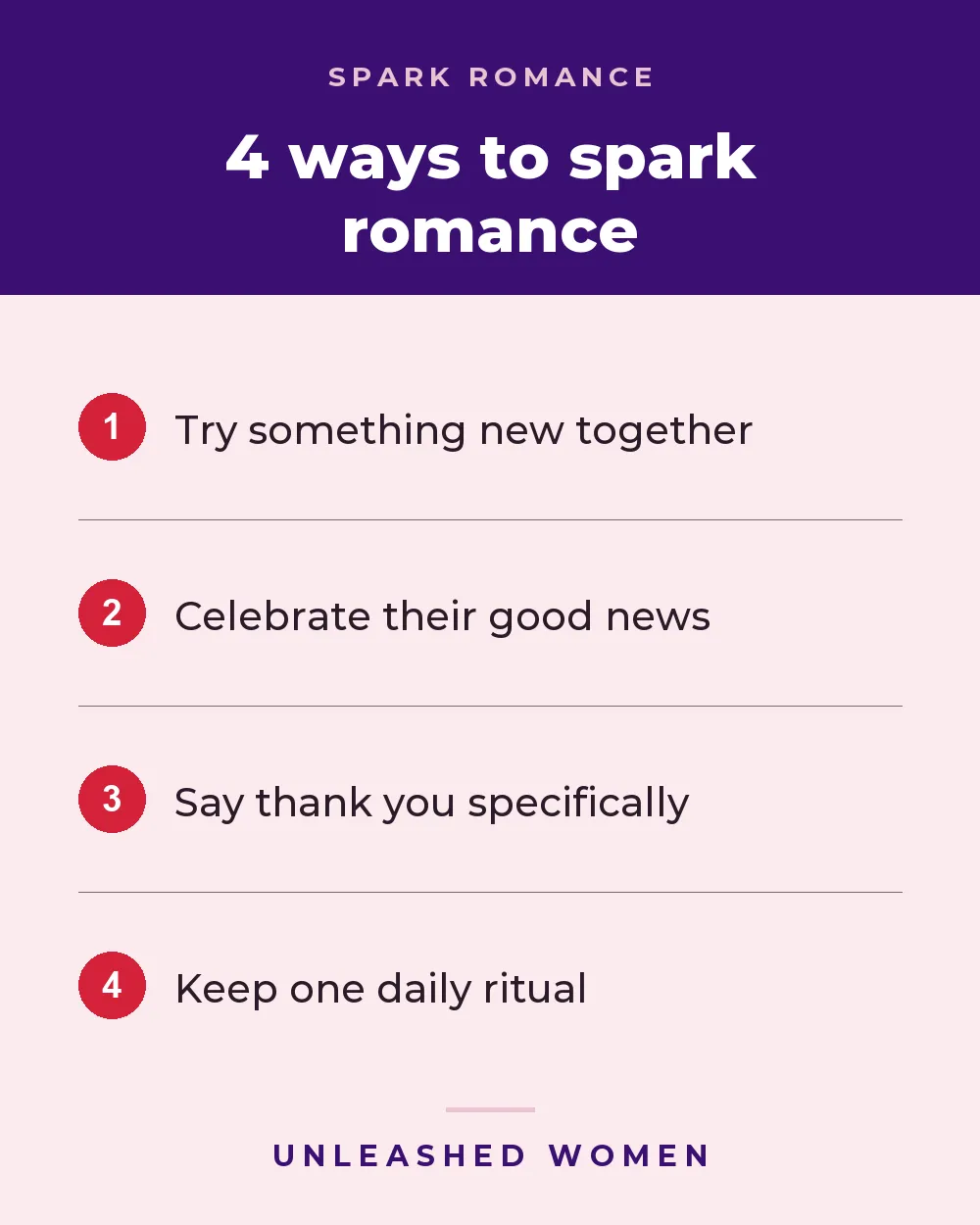
The simplest ways to spark romance are small and regular: try something new together, respond with real excitement when your partner shares good news, thank them for specific things, and protect a few daily rituals like a long kiss hello or a phone-free dinner.
Romance in long relationships usually fades through routine, not lost love, so the fix is less about grand gestures and more about bringing back novelty and attention.
Below are 25 ideas, most of them free, grouped by how much time they take.

Why romance fades, and what helps
Early romance runs on newness.
Everything is a first.
Over time, life becomes familiar, and familiar can slide into boring.
Research backs up the idea that novelty matters.
In a set of studies published in the Journal of Personality and Social Psychology in 2000, psychologist Arthur Aron and colleagues found that couples who reported doing exciting things together were more satisfied, partly because they felt less bored.
In lab experiments, couples who did a short, novel, active task together reported a bigger lift in relationship quality than couples who did something mundane.
Attention matters too.
In a 2006 study of 79 dating couples, Shelly Gable and colleagues found that how partners responded to each other’s good news was more closely linked to relationship well-being two months later than how they responded to bad news.
So the two levers are simple: do new things together, and pay warm attention to each other.
How to use this list
Don’t try all 25.
Pick two or three that feel natural and do them for two weeks.
Mix one quick daily habit with one bigger idea.
And involve your partner.
Romance lands better when it’s shared, not performed at someone.
Two-minute sparks you can do every day
- The six-second kiss. Kiss hello and goodbye for six seconds instead of a quick peck. It’s long enough to feel like a moment. Gottman-trained therapist Terry Gaspard lists it as one of five rituals of connection.
- Celebrate their good news out loud. When they share a win, stop what you’re doing, ask a follow-up question, and look happy for them. “Wait, tell me everything.”
- Say a specific thank-you. “Thanks for making coffee before my early meeting” beats “thanks for everything.” Research on gratitude in couples suggests it helps most when it feels genuine and responsive, not routine.
- Turn toward small bids. When they point out a funny dog or a song, respond. In John Gottman’s newlywed research, couples still together six years later had turned toward these bids about 86% of the time.
- Send a mid-day message that isn’t logistics. “Thinking about last Saturday, that was fun” instead of “can you get milk.”
- Touch in passing. A hand on the back, a hug in the kitchen, holding hands on a walk.
- Ask one real question. “What was the best part of your day?” and then actually listen.
Twenty-minute connections
- A stress-reducing chat. Twenty minutes, once a day, where each of you vents about your day outside the relationship and the other just listens and takes your side.
- Phone-free dinner. Plates on the table, phones in another room. Even two nights a week gives you back conversations that screens quietly steal.
- A walk after dinner. Same route or a new one, side by side, no destination. Walking next to each other often makes harder topics easier to raise.
- Dance in the kitchen. One song, while the pasta boils. Silly counts, and laughing together is part of the point.
- Read each other something. A paragraph from a book, a funny post, a short poem. It’s a small way of saying “I thought of you.”
- Plan the next date together. The anticipation is part of the fun. Take turns choosing so it never becomes one person’s job.
- Look through old photos. Pick one trip or early memory and tell the story of it together. Notice the details each of you remembers differently.
Evenings in
- Cook something neither of you has made before. Shop together, split the jobs, eat what you made, even if it’s a disaster.
- A themed night. Pick a country: food, music and a film from there. Let one person plan the food and the other the music.
- Recreate your first date at home, or as close as you can get. Same food, same playlist, and swap what you each remember about that night.
- A no-TV evening. Board game, cards, a puzzle, or just talking on the floor with a candle. Boredom is often where the best conversations start.
- Write each other a note. Three things you love about them right now. Swap and read them out loud.
New adventures together

- Explore one new place nearby. A neighborhood, café or park you’ve never visited. New doesn’t have to mean far, and you can treat yourselves like tourists for an afternoon.
- Take a one-off class. Pottery, salsa, climbing, cooking. Being beginners together is a great equalizer.
- Try something that gets your heart rate up. A hike with a view, a bike ride, an escape room. In Aron’s experiments, the novel task was also a little physical and exciting.
- Plan a mini-adventure. A sunrise, a day trip, a night somewhere you’ve never slept. Keep the plan loose enough to leave room for surprises.
- Learn something together. A language, a skill, a recipe a week. Progress you make side by side becomes a shared story.
- Say yes to their idea. Pick the thing they’ve been suggesting that you keep putting off, and do it with good grace.
A two-week starter plan
If you want a simple way to begin, try this:
- Week one: Start the six-second kiss and one specific thank-you a day. Add one phone-free dinner.
- Week two: Keep those going and add one new activity together, something neither of you has done before.
- At the end: Ask each other, “What did you enjoy most?” Keep that one and add another.
Small and steady beats big and rare.
A romantic weekend away is lovely, but daily warmth is what makes the weekend feel like you.
When it’s more than a rut
Sometimes romance fades because of something deeper.
Ideas from a list can’t fix resentment, constant criticism, or feeling unsafe.
| Evidence | Shared novel activities and warm responses to good news are linked with higher relationship quality in peer-reviewed studies. |
| Interpretation | If you’re mostly bored or busy, new experiences and small rituals are a reasonable first step. |
| Unknown | Whether romance can come back if the real issue is unresolved hurt or contempt. That usually needs a direct conversation, and sometimes a counselor. |
If any of these feel familiar, start with a conversation before planning romance:
- We avoid talking about something important
- One of us often feels criticized or dismissed
- Affection feels like an obligation, not a choice
- I feel nervous about how my partner will react
Frequently Asked Questions
How do you spark romance in a long-term relationship?
Bring back novelty and attention.
Try one new activity together every week or two, and build small daily rituals like a long kiss hello, a phone-free dinner and specific thank-yous.
Consistency matters more than size.
Is it normal for romance to fade?
Yes.
Early excitement is driven by newness, and that naturally settles as life becomes familiar.
Fading romance usually reflects routine and busyness, not a lack of love, and it often responds well to small, regular changes.
What are cheap romantic ideas?
Most of this list is free: a six-second kiss, a walk after dinner, dancing in the kitchen, a themed night in, writing each other notes, or exploring a new part of town.
What matters is attention and novelty, not money.
How often should couples have date nights?
There’s no magic number.
Many couples find a weekly or every-other-week date, at home or out, is easy to keep up.
Regularity matters more than how fancy it is, and it helps to take turns choosing what you do.
What if my partner isn’t interested in romance right now?
Start smaller and ask.
“I miss doing fun things together, would you be up for a walk on Sunday?” is easier to say yes to than a big plan.
If the lack of interest feels like distance rather than tiredness, a gentle check-in conversation may need to come first.
Disclaimer: This article is general educational information about dating and relationships. It is not therapy, counseling, medical advice or legal advice, and it cannot tell you what another person thinks or guarantee any outcome. If you feel unsafe, contact local emergency services or the National Domestic Violence Hotline (1-800-799-7233).
Sources
- Couples' shared participation in novel and arousing activities and experienced relationship quality — Journal of Personality and Social Psychology (Aron, Norman, Aron, McKenna & Heyman, 2000), via APA PsycNet
- Will you be there for me when things go right? Supportive responses to positive event disclosures — Journal of Personality and Social Psychology (Gable, Gonzaga & Strachman, 2006), via PubMed
- 5 Rituals to Reconnect in Your Relationship — The Gottman Institute (Terry Gaspard, MSW, LICSW)
- Positive Psychology in Context: Effects of Expressing Gratitude in Ongoing Relationships Depend on Perceptions of Enactor Responsiveness — The Journal of Positive Psychology (Algoe & Zhaoyang, 2015), via PMC
- Turn Towards Instead of Away — The Gottman Institute (Zach Brittle, LMHC)