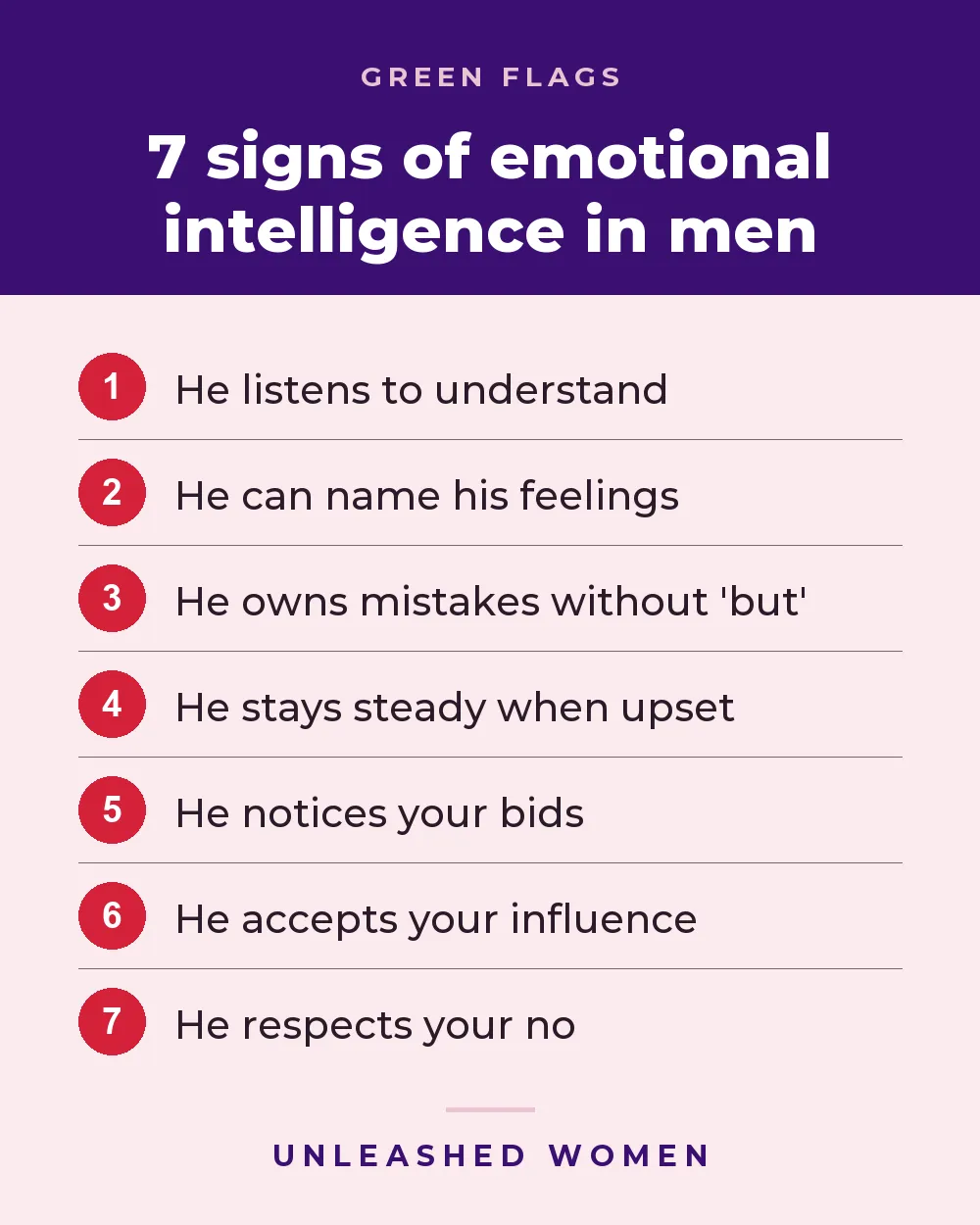
The clearest signs of emotional intelligence in men are behaviors you can see: he listens to understand, he can name what he feels, he owns mistakes without excuses, he stays steady when he’s upset, he notices when you reach for connection, he lets your opinion change his mind, and he takes your “no” without punishing you for it.
None of these require a perfect man.
They require a man who can handle feelings, his and yours, without making them your problem.

Why emotional intelligence matters more than chemistry
Emotional intelligence is the ability to notice, understand and manage emotions, your own and other people’s.
It isn’t a personality type.
It’s a set of skills, and skills show up in behavior.
It also matters for how a relationship feels.
A 2014 meta-analysis in The American Journal of Family Therapy, pooling six studies and 603 participants, found a moderate link between a person’s emotional intelligence and relationship satisfaction, including their partner’s satisfaction.
Chemistry tells you how someone makes you feel tonight.
Emotional intelligence tells you how a hard week will go.
How to use this list
Don’t use it as a scorecard on date one.
Everyone is on their best behavior early, and everyone has off days.
Use it as a lens over the first few weeks.
Look for patterns, not single moments.
And notice the signs in yourself too.
These are skills both people bring to a relationship.
The 7 signs at a glance
Here is the short version to save, with the detail for each sign below.
- He listens to understand, and asks a follow-up question before sharing his own story.
- He can name what he feels in simple words, like “nervous,” “disappointed” or “proud.”
- He owns small mistakes with a clean apology and no “but.”
- He stays respectful when he’s frustrated, and asks for a break instead of shutting down.
- He notices and responds when you reach for connection, even in tiny ways.
- He lets your opinion change his mind sometimes, while still having his own.
- He accepts your “no” the first time, without sulking, guilt or pressure.
1. He listens to understand, not just to reply
You tell him about a frustrating day and he asks a follow-up question instead of jumping to his own story.
He doesn’t rush to fix it unless you ask.
He might say, “That sounds exhausting.
Do you want advice or just to vent?”
On a date, look for: questions that build on what you just said, eye contact, his phone staying in his pocket.
What it isn’t: silent nodding while he waits for his turn, or remembering every detail but never asking how you felt.
2. He can name what he feels
He says “I’m a bit nervous about this job interview” or “That comment stung” instead of going quiet or getting snappy.
Naming feelings is more than being open.
In a 2007 brain-imaging study published in Psychological Science, putting feelings into words reduced activity in the amygdala, a brain region involved in emotional reactions, compared with other ways of processing the same images.
On a date, look for: simple feeling words used naturally.
“I was disappointed,” “I felt proud,” “I’m not sure how I feel yet.”
What it isn’t: big emotional speeches on date two.
Steady, everyday honesty is the skill.
3. He owns mistakes without a “but”
He’s late and says, “I’m sorry, I should have left earlier.
Thanks for waiting.”
Full stop.
The Gottman Institute describes defensiveness as a way of shifting blame, and its opposite as simply accepting responsibility for your part, even a small one.
On a date, look for: a clean apology for a small thing, with no excuse attached.
What it isn’t: “I’m sorry you feel that way,” or an apology followed by a list of reasons it was really your fault.
4. He stays steady when he’s upset
He’s frustrated, maybe angry, but he doesn’t yell, sulk for days, or disappear.
If he needs time, he says so: “I’m getting worked up.
Can we take a break and talk in a bit?”
Then he comes back.
The Gottman Institute recommends exactly that: when someone feels flooded, a break of about 20 minutes doing something soothing, followed by returning to the conversation, works better than shutting down.
On a date, look for: how he handles a long wait, a wrong order, a rude driver, or a plan that falls through.
What it isn’t: never getting upset.
Calm on the surface while he goes silent for three days isn’t regulation.
5. He notices when you reach for connection
You point out a dog on the street, share a song, or mention you’re worried about your sister.
He responds, even briefly.
Relationship researcher John Gottman calls these moments “bids.”
In his newlywed research, couples who were still married six years later had turned toward each other’s bids about 86% of the time; couples who divorced had done so about 33% of the time.
On a date, look for: small responses.
“Oh, that’s a cute dog.”
“How’s your sister doing now?”
What it isn’t: grand gestures paired with ignoring everyday moments.
6. He lets your opinion change his mind
You suggest a different restaurant, a different plan, or a different way to see something, and he genuinely considers it.
Sometimes he even says, “Good point, let’s do that.”
The Gottman Institute calls this accepting influence.
In a study of 130 newlywed couples, men who allowed their wives to influence them had happier marriages and were less likely to divorce.
On a date, look for: flexibility on small things, curiosity about your view, and an occasional “I hadn’t thought of it that way.”
What it isn’t: agreeing with everything to keep you happy.
Accepting influence still includes having his own opinions.

7. He respects your “no” without punishing you for it
You say you’re not ready to meet his friends yet, or you’d rather go home early.
He says “Sure” and means it.
There’s no sulking, no guilt trip, no cold shoulder the next day.
On a date, look for: how he responds to the first small no. That moment tells you more than any compliment.
What it isn’t: “Fine” said through clenched teeth, or bringing it up again and again until you give in.
Charm vs. emotional intelligence
Charm and emotional intelligence can look alike for the first few dates.
Both are attentive, warm and fun.
The difference shows up under mild stress.
| Moment | Charm | Emotional intelligence |
|---|---|---|
| You disagree with him | Smooths it over, changes the subject | Asks why you see it that way |
| He makes a mistake | Jokes it away | Apologizes clearly |
| You say no | Turns on more charm to change your mind | Accepts it |
| He’s had a bad day | Hides it, or takes it out on you | Tells you, without making it your job to fix |
What you can know, what you might guess, and what you can’t
| Evidence | What he does, repeatedly: how he listens, apologizes, handles frustration and responds to your no. |
| Interpretation | A consistent pattern of these behaviors suggests skills he’ll bring to harder moments. A pattern of defensiveness or punishing silence suggests the opposite. |
| Unknown | What he feels inside, and whether early behavior will hold under bigger stress. Only time and repeated situations show that. |
A 30-day observation checklist
Use this over your first month, privately.
One tick isn’t a verdict.
Patterns are.
- He asked a follow-up question about something that mattered to me
- He named a feeling of his own at least once
- He apologized for something small without an excuse
- I saw him frustrated, and he stayed respectful
- He responded to small moments I shared
- He changed a plan or view because of something I said
- He accepted a no without sulking or pushing
- I feel calmer, not more anxious, after time with him
Frequently Asked Questions
What are the signs of an emotionally intelligent man?
Look for behavior you can see: he listens to understand, names his feelings, apologizes without excuses, stays respectful when upset, responds to small moments of connection, lets your view influence him, and accepts your no. Watch for these as patterns over weeks, not single moments.
Can a man become more emotionally intelligent?
Yes.
Emotional intelligence is a set of skills, and skills can grow with practice, feedback and sometimes therapy.
What matters early on is whether he’s willing to notice and work on it, which you’ll see in how he responds to gentle feedback.
Is emotional intelligence the same as being sensitive?
No. Someone can be very sensitive and still struggle to manage their reactions or notice yours.
Emotional intelligence includes handling feelings well, not only having them.
How soon can you tell if a man is emotionally mature?
You’ll see early hints within a few dates, but a clearer picture usually takes weeks, because the most telling moments are small conflicts, disappointments and your first no. Give it time and watch for consistency.
Disclaimer: This article is general educational information about dating and relationships. It is not therapy, counseling, medical advice or legal advice, and it cannot tell you what another person thinks or guarantee any outcome. If you feel unsafe, contact local emergency services or the National Domestic Violence Hotline (1-800-799-7233).
Sources
- Trait emotional intelligence and romantic relationship satisfaction: A meta-analysis — The American Journal of Family Therapy (Malouff, Schutte & Thorsteinsson, 2014), via APA PsycNet
- Emotionally Intelligent Husbands are Key to a Lasting Marriage — The Gottman Institute (Kyle Benson)
- Putting feelings into words: affect labeling disrupts amygdala activity in response to affective stimuli — Psychological Science (Lieberman et al., 2007), via PubMed
- Turn Towards Instead of Away — The Gottman Institute (Zach Brittle, LMHC)
- The Four Horsemen: Criticism, Contempt, Defensiveness, and Stonewalling — The Gottman Institute (Dr. Ellie Wilde)