To get out of a dating slump, stop pushing harder and start by resting.
Most slumps are a sign of burnout from too much swiping and too little reward, not a sign that something is wrong with you.
Take a real break of a week or two, refill the parts of your life that have nothing to do with dating, get clear on what you actually want, and then come back smaller: one app, short sessions, fewer and better conversations, and more ways of meeting people offline.

Signs your dating slump is really burnout
A slump isn’t just “no dates lately.”
It’s how dating has started to feel.
You might be burnt out if:
- Opening the app feels like doing your taxes.
- You swipe left on almost everyone without really looking.
- Conversations feel like the same three questions on repeat.
- A match going quiet stings more than it used to, or you feel nothing at all.
- You’ve started thinking “it’s probably me.”
- You keep going because stopping feels like giving up.
That last one matters.
Researchers studying dating apps describe burnout in three parts: feeling emotionally exhausted, feeling like nothing you do works, and becoming detached or cynical about the people you’re meeting.
Why it happens (it’s not just you)
If dating feels harder than it should, you’re in good company.
In a Pew Research Center survey, Americans who had used a dating site or app in the past year were more likely to say it left them feeling frustrated (45%) than hopeful (28%).
A later Pew report found that about twice as many recent online daters often feel disappointed as often feel excited, and that women were about three times as likely as men to often feel overwhelmed by the number of messages.
Endless choice can also quietly change how you date.
In three studies published in Social Psychological and Personality Science, psychologists Tila Pronk and Jaap Denissen found that people became more rejecting the longer they swiped.
On average, the chance of accepting a profile fell by about 27% from the first to the last option, as satisfaction and people’s sense of their own dating success dropped.
They called it a “rejection mind-set.”
And burnout tends to build.
A 2024 study in New Media & Society followed single app users over 12 weeks and found their emotional exhaustion and sense of not getting anywhere grew over time, especially for people who felt lonely or anxious, or who used the apps compulsively.
The short version: the more you push through a slump, the flatter it can get.
Step 1: Take a real break, not a guilty one
A break works best when it’s a decision, not a lapse.
- Pick a length. Two weeks is a good start. A month is fine too.
- Hide or delete the apps. Pausing your profile means no notifications pulling you back.
- Tell yourself why. “I’m resting so I can date better,” not “I’ve given up.”
- Close loops kindly. If you’re mid-conversation with someone, a simple “I’m taking a short break from the apps, it was nice chatting” is enough.
You’re not losing time.
You’re stopping the slide described above, where more swiping makes you more rejecting and more discouraged.
Step 2: Refill your own life
A slump often means dating has crowded out the things that make you feel like yourself.
Use the break to add back:
- Time with friends who already like you as you are.
- One thing you’re getting better at: a class, a sport, a project.
- Plans you’d enjoy whether or not anyone romantic is there.
- Rest. Real rest, not scrolling.

These aren’t a strategy to meet someone.
They’re a way to stop needing dating to make your week feel good.
That shift alone often changes how you show up on the next date.
Step 3: Get clear on what you actually want
Burnout blurs your goals.
Before you go back, write down short answers to these:
- What am I looking for right now: something serious, something casual, or just company?
- What were the two best dates I’ve had, and what made them good?
- What are my three must-haves, and my two dealbreakers?
- What kind of first date do I actually enjoy?
Keep it short.
You’re aiming for a compass, not a checklist of 40 traits.
Step 4: Come back smaller
When you return, change the shape of dating, not just the effort.
Limit your swiping. Set a timer for 15 minutes, once a day or a few times a week.
When it rings, stop.
Given what the rejection mind-set research suggests, fewer profiles viewed with more attention is likely better than more profiles with less.
Keep only two or three conversations going. Enough to feel hopeful, not so many you can’t remember who’s who.
Move to meeting sooner. If a conversation is going well, suggest a short coffee or walk within a week or so.
Long text threads can build a version of someone who doesn’t exist.
Choose low-pressure first dates. 45 to 60 minutes, somewhere you’d enjoy anyway.
If it’s not a match, you still had a nice walk.
Add one offline path. A class, a run club, a friend’s dinner, a volunteer shift.
You don’t have to treat it as dating.
It just widens the ways you meet people.

Notice your self-talk. When a match goes quiet, try “That wasn’t my person” instead of “What’s wrong with me?”
Scripts for coming back
A few lines that make the first steps easier:
Pausing a chat before your break: “I’m taking a couple of weeks off the apps.
I’ve enjoyed talking, and I didn’t want to just disappear.”
Suggesting a first meeting: “I’m enjoying this.
Would you like to grab a coffee or go for a walk on Saturday afternoon?”
Ending a first date kindly: “Thanks for today, I had a nice time.
I don’t think we’re a match, but I wish you the best.”
When a friend asks how dating’s going: “I took a break and I’m coming back slower this time.
It feels better already.”
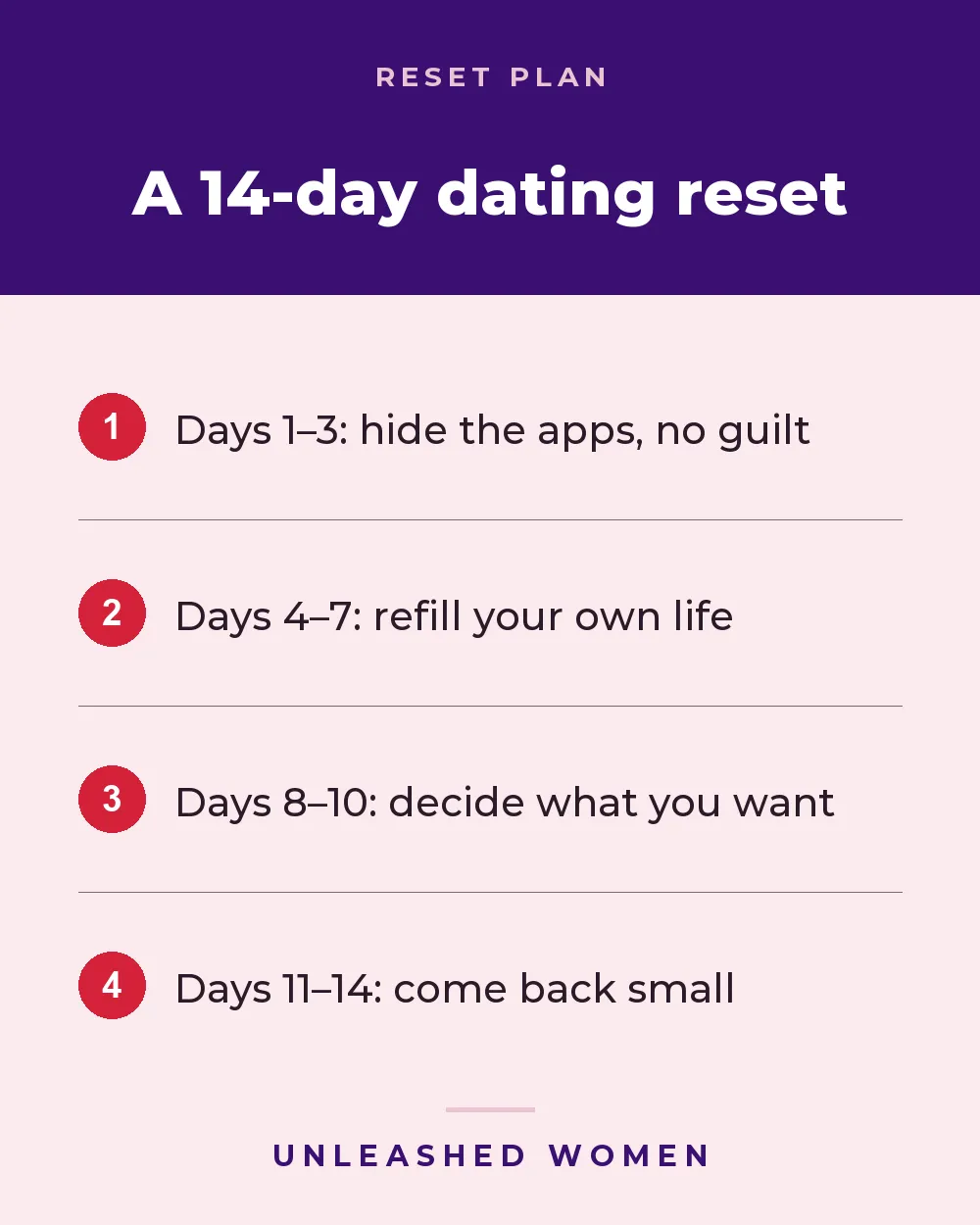
Your 14-day reset checklist
- Days 1–3: Apps hidden or deleted, no guilt
- Days 4–7: Two plans with friends or for yourself
- Days 8–10: Wrote down what I want, must-haves and dealbreakers
- Day 11: Reinstalled one app (only one)
- Days 11–14: Swiping limited to 15 minutes a session
- Day 14: Suggested meeting one person I genuinely liked talking to
What we know, what it might mean, and what nobody can promise
| Evidence | Large surveys show frustration and disappointment are common among online daters. Studies link long swiping sessions with becoming more rejecting, and app use over time with growing burnout. |
| Interpretation | Your slump is probably at least partly about how you’ve been dating, not who you are. Resting and changing your approach are reasonable responses. |
| Unknown | How long your slump will last, or whether a break will lead to a relationship. What it can change is how dating feels and how clearly you choose. |
Frequently Asked Questions
How long should a dating break be?
Long enough to stop feeling dread when you think about dating, often two to four weeks.
Pick a length in advance so it feels like a choice, and check in with yourself at the end rather than drifting back out of guilt.
Is it normal to feel burnt out from dating apps?
Yes.
Researchers describe dating app burnout as emotional exhaustion, a sense that nothing is working, and growing cynicism, and a 2024 study found it tends to build over time with regular use.
Feeling it doesn’t mean you’re bad at dating.
How do I get back into dating after a slump?
Come back smaller: one app, short timed swiping sessions, two or three conversations at most, and an early suggestion to meet.
Add at least one offline way of meeting people so the apps aren’t your only option.
Should I delete my dating apps completely?
You don’t have to.
Hiding or pausing your profile works for a short break, and keeps your matches if you want to return.
If the apps reliably leave you feeling worse, deleting them for longer and meeting people through friends, classes and events is a perfectly good way to date.
What if the slump is really about feeling low in general?
A dating slump can overlap with feeling low or lonely more broadly.
If your mood stays down for weeks, affects sleep or work, or feels heavier than a slump, it’s worth talking to a doctor or therapist.
Disclaimer: This article is general educational information about dating and relationships. It is not therapy, counseling, medical advice or legal advice, and it cannot tell you what another person thinks or guarantee any outcome. If you feel unsafe, contact local emergency services or the National Domestic Violence Hotline (1-800-799-7233).
Sources
- 2. Users of online dating platforms experience both positive – and negative – aspects of courtship on the web — Pew Research Center
- The experiences of U.S. online daters — Pew Research Center (Colleen McClain, Risa Gelles-Watnick, 2023)
- A Rejection Mind-Set: Choice Overload in Online Dating — Social Psychological and Personality Science (Pronk & Denissen, 2020)
- Burnt out and still single: Susceptibility to dating app burnout over time — New Media & Society (Sharabi, Von Feldt & Ha, 2024)