To set boundaries early in a relationship, get clear on your own limits first, then say them simply and kindly as soon as they come up: “I like texting during the day, but I keep my phone away after 10.”
Start with a request, follow it with what you’ll do if it isn’t respected, and keep it about your needs rather than his behavior.
Then pay attention to the response, because how someone handles a small, calm boundary tells you a lot about how they’ll handle bigger ones.

What a boundary is (and what it isn’t)
A boundary is a line that protects your time, body, feelings, privacy or money.
It’s about what you need, not about controlling someone else.
The healthy-relationships nonprofit love is respect describes boundaries as being, in a way, about your relationship with yourself: they help you honor your own needs, goals and values.
It helps to separate three things that often get mixed up.
Coach and author Hailey Magee, writing for the Gottman Institute, puts it like this:
| What it sounds like | What it does | |
|---|---|---|
| Request | “Could you text if you’re running late?” | Asks the other person to do something. Usually your first step. |
| Boundary | “If you’re more than 20 minutes late without a text, I’ll head home.” | States what you will do. Used if a request isn’t met. |
| Ultimatum | “Stop seeing your friends or we’re done.” | Tries to control the other person. Not a boundary. |
Most early boundaries are really requests.
That’s good news: they’re easier to say and easier to hear.
Know your lines before you need them
You can’t say a boundary you haven’t found yet.
And it’s much harder to find it in the middle of a date when you’re trying to be easygoing.
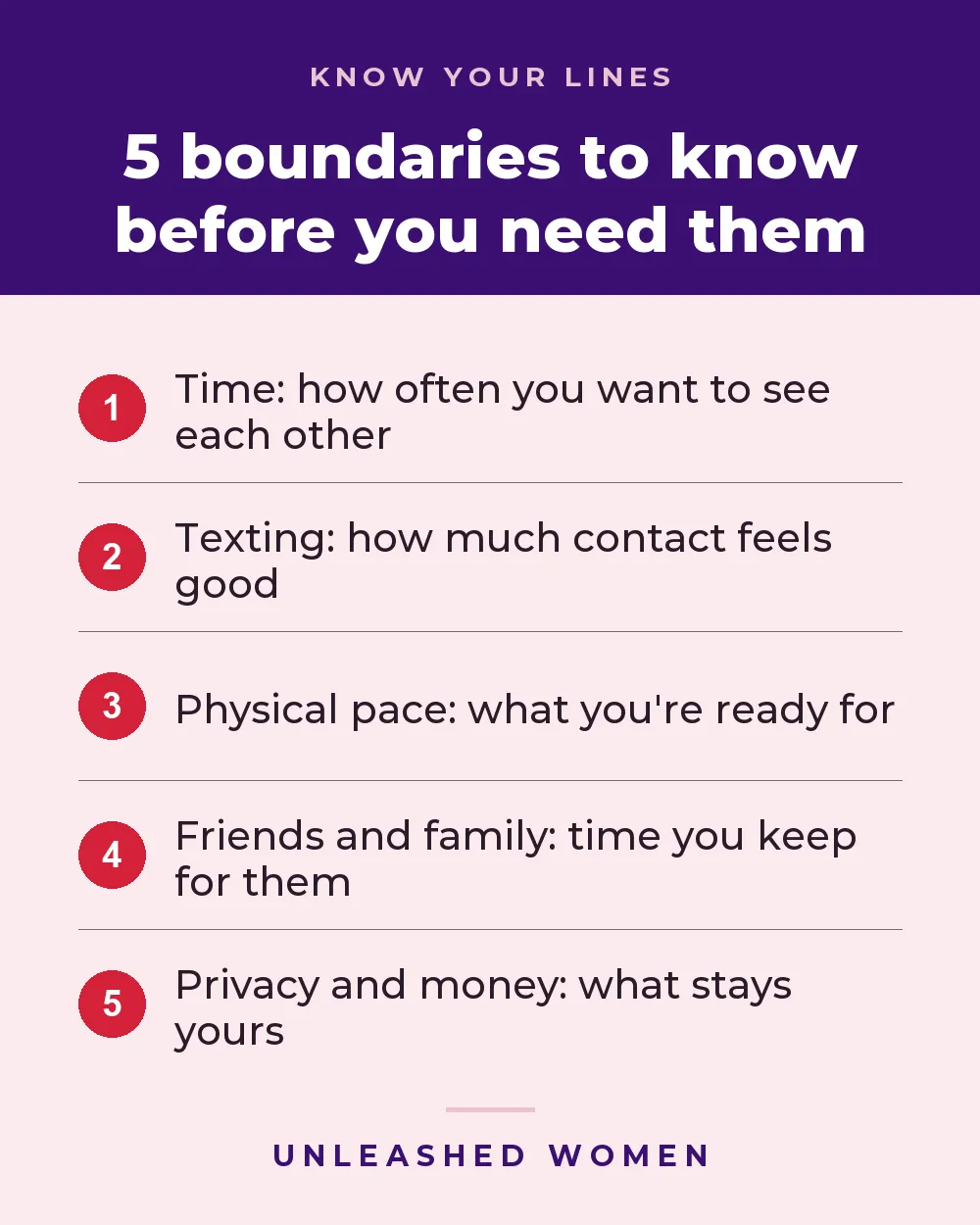
Think through these five areas before things get serious.
Love is respect lists physical, emotional, financial and digital boundaries, and suggests deciding what feels comfortable to you before you talk to a partner.
Time. How often do you want to see each other right now?
How many evenings do you need for yourself, your friends, your sleep?
Texting and phones. Is a good-morning text lovely or pressure?
Are you OK sharing passwords?
(You never have to, even if you trust someone.)
Physical pace. What are you comfortable with, and what are you not ready for yet?
Friends and family. When do you want to meet each other’s people?
Which weekends are already spoken for?
Privacy and money. What stays yours for now: your phone, your past, your finances?
A useful prompt from love is respect: notice what makes you uncomfortable in your own life, and even in shows and movies.
Those reactions point to your lines.

Write your answers down.
Something on paper feels more legitimate than a vague uneasy feeling, and it’s much harder to talk yourself out of.
When to bring it up
You don’t need a big “boundaries talk” on date two.
Say it when it becomes relevant:
- The first time a plan doesn’t suit you.
- The first time the texting pace feels like too much.
- The first time someone pushes past a “maybe” or a “not yet.”
Early and small beats late and big.
Saying “I’m not a big late-night texter” in week two is a one-sentence aside.
Saying it in month four, after weeks of resentment, can feel like an accusation.
Scripts for six early-dating situations
The Gottman Institute’s research on conflict found that conversations tend to end the way they begin.
Starting with “I” instead of “you” keeps the temperature low.
Use the shape: what I like + what I need + (if needed) what I’ll do.
He wants to see you every day. “I’m really enjoying this, and I want to keep enjoying it.
I also need a few nights to myself each week.
How about Wednesday and Saturday?”
The texting is more than you want. “I love hearing from you.
I’m not great at texting during work, so if I’m slow to reply it just means I’m busy.”
Things are moving faster physically than you want. “I like you and I want to take this part slowly.
I’ll tell you when I’m ready for more.”
He’s talking about the future very fast. “It’s sweet that you’re thinking ahead.
I like to take things one step at a time, so let’s enjoy getting to know each other for now.”
He keeps cancelling at the last minute. First a request: “Could you give me a bit more notice if plans change?”
If it keeps happening, a boundary: “If plans change on the day, I’ll go ahead with my own evening and we can rebook.”
A conversation turns into put-downs. The Gottman Institute suggests naming your limit calmly in advance: “I want to talk about this, but not if it turns into personal attacks.
If it does, I’ll step away and we can try again later.”

One thing these scripts don’t do: apologize, over-explain, or ask permission to have a need.
One sentence of reason is plenty.
What their response tells you, and what it doesn’t
How someone reacts to a calm, small boundary is some of the most useful information you’ll get early on.
There’s research behind paying attention to it.
In a seven-day diary study of 99 couples published in Frontiers in Psychology in 2021, sharing your own needs and feeling that your partner was responsive to them were both linked with higher day-to-day satisfaction.
| What you can go on | |
|---|---|
| Evidence | What he actually did after you said it: adjusted, asked a question, sulked, argued, ignored it, or pushed again. |
| Interpretation | “Thanks for telling me” plus a change in behavior suggests he can hear a no without making it a crisis. Repeated pushback after a clear, kind boundary suggests he may not respect your limits. |
| Unknown | Why he reacted the way he did. Tiredness, his own insecurity, or plain disinterest all look similar from the outside. You don’t need to know why to decide what you’ll accept. |
If he pushes back once, you can repeat it once, calmly: “I hear that you’re disappointed, and I still need this.”
Then watch what happens next.
Warning signs to take seriously
Love is respect draws a clear line between healthy and unhealthy boundaries.
A healthy one protects you.
An “unhealthy boundary” tries to control the other person.
Take note if:
- You feel afraid to state a boundary because of how he might react
- He tells you who you can see or text, and calls it a “boundary”
- He asks for your passwords or location and gets angry when you say no
- He keeps pushing after a clear no, or makes you justify it again and again
- You’ve started shrinking your life, friends or plans to avoid upsetting him
Love is respect is explicit that being afraid to talk about your boundaries because a partner might react with anger or violence is a warning sign of an unhealthy or abusive relationship.
If any of this sounds familiar, you can talk it through confidentially with a love is respect advocate.
Frequently Asked Questions
How do I set boundaries without seeming too much?
Keep it short, warm and about you: “I like X, I need Y.” One sentence of reason is enough, and you don’t need to apologize.
A boundary said calmly early on almost always lands better than one said in frustration later.
When should you set boundaries in a new relationship?
As soon as the situation comes up, not in a formal talk.
The first time the texting pace, a plan or the physical pace doesn’t suit you is the right time, because it’s smaller and easier to say then.
What if he gets upset when I set a boundary?
Repeat it once, calmly, without extra justification.
Then notice what he does next.
Someone who respects you may feel disappointed but will adjust.
Someone who keeps pushing, sulking or making you feel guilty is showing you how he’ll handle your needs later.
Can boundaries change as a relationship grows?
Yes.
Love is respect notes that boundaries can change, as long as you’re changing them because you want to, not because you’re being pressured.
It’s normal to relax some boundaries as trust builds and to add new ones as life changes.
Is it controlling to set boundaries?
Not when they’re about your own choices.
“I won’t text after 11” is a boundary.
“You can’t text other women” is an attempt to control someone else.
The first protects you; the second limits him.
Disclaimer: This article is general educational information about dating and relationships. It is not therapy, counseling, medical advice or legal advice, and it cannot tell you what another person thinks or guarantee any outcome. If you feel unsafe, contact local emergency services or the National Domestic Violence Hotline (1-800-799-7233).
Sources
- What are my boundaries? — love is respect (National Domestic Violence Hotline project)
- How to create boundaries in romantic relationships — love is respect
- Requests Vs. Boundaries Vs. Ultimatums: The Ultimate Guide — The Gottman Institute (Hailey Magee)
- Conversational Boundaries without Stonewalling — The Gottman Institute
- How to Fight Smarter: Soften Your Start-Up — The Gottman Institute (Dr. Ellie Wilde)
- The Role of Relational Entitlement, Self-Disclosure and Perceived Partner Responsiveness in Predicting Couple Satisfaction: A Daily-Diary Study — Frontiers in Psychology (Candel & Turliuc, 2021), via PMC