The best new relationship checklist is short and observable: they respect your “no”, stay steady when there’s friction, keep a life of their own, really listen, share your big-picture direction, treat privacy and pace as a two-way choice, and leave you feeling calmer rather than more anxious.
You don’t need to interrogate anyone or stop enjoying the spark.
You just need to keep one grounded part of yourself watching for these seven things over the first few months.
Why the first few months look different
The first stretch of a relationship is a highlight reel.
People are more patient, more attentive and more available than they will be on an ordinary Tuesday a year from now.
That isn’t dishonesty; it’s how all of us behave when we’re excited and trying to make a good impression.
Relationship researchers have described a typical decline in relationship quality after the early “honeymoon” period.
In work by psychologist Arthur Aron and colleagues, couples who kept doing new, mildly exciting things together reported higher relationship quality, which suggests the early glow isn’t automatic; it’s partly built.
For you, the practical takeaway is simple: early behavior is real, but consistency over time is the information you actually need.
That’s why this checklist works as an observation window rather than a test.
Give it roughly the first three months.
Enjoy everything, avoid making permanent decisions too fast, and notice what stays the same once the novelty settles.

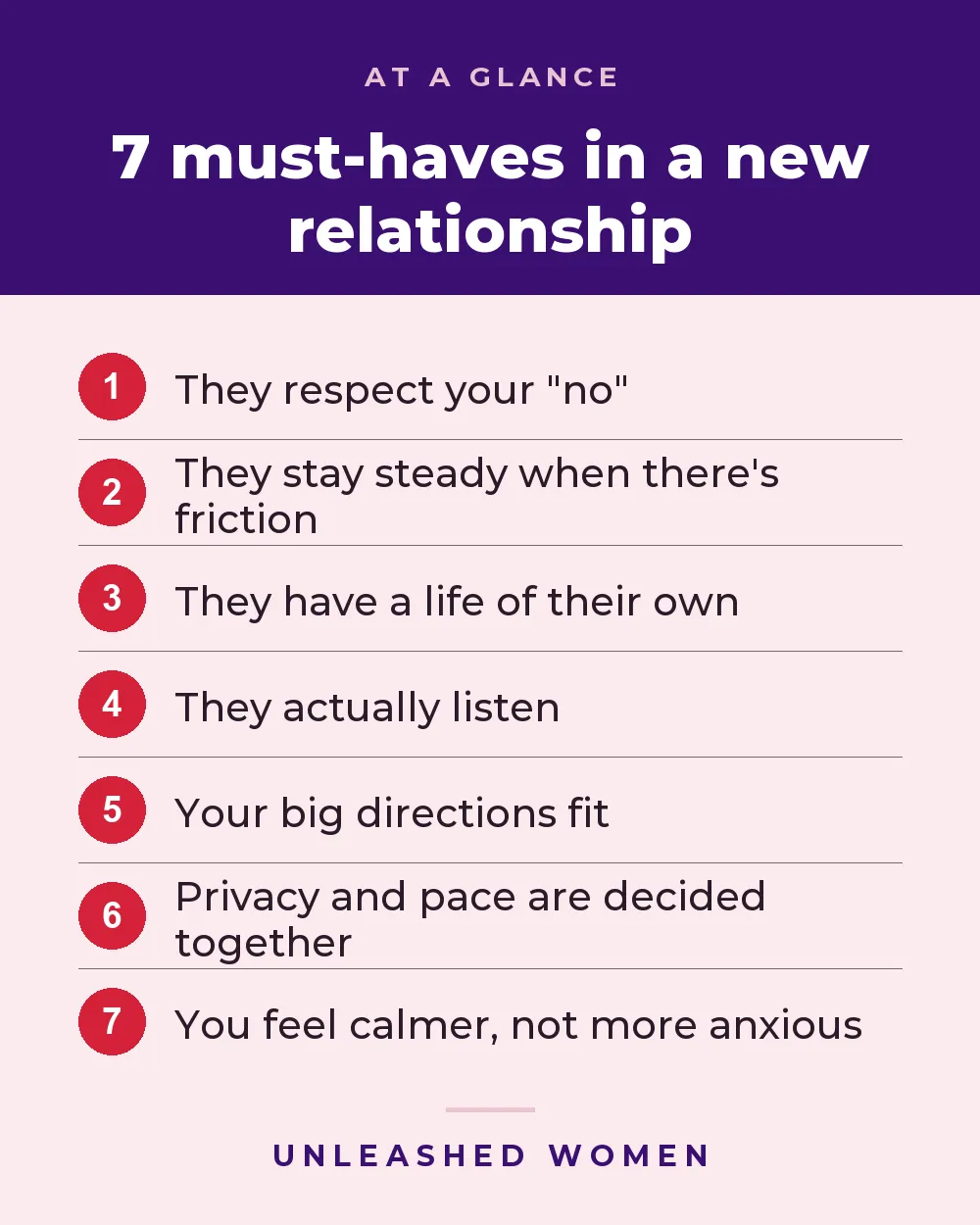
The 7 must-haves at a glance
- They respect your “no”.
- They stay steady when there’s friction.
- They have a life of their own, and they respect yours.
- They actually listen.
- Your big directions are compatible.
- Privacy and pace are decided together.
- You feel calmer, not more anxious.
None of these require a dramatic conversation.
They show up in ordinary moments: a cancelled plan, a small disagreement, a busy week.
Must-haves 1 to 3: respect, steadiness and a full life
**1.
They respect your “no”.**
This is the quiet green flag that tells you the most.
If you say you’re tired and can’t come out, do they reply with “No problem, rest up,” or do they go cold, push, or make you feel guilty?
The nonprofit love is respect describes healthy partners as people who respect boundaries once they’ve been shared.
Someone who handles a small “no” graciously is showing you how they’re likely to handle bigger ones.
**2.
They stay steady when there’s friction.**
Every couple disagrees, even early on.
Watch the how.
Research summarized by the Gottman Institute identifies four patterns that damage conflict: criticism, contempt, defensiveness and stonewalling.
The healthier alternatives are softer: starting gently, taking responsibility for their part, and pausing when emotions run high.
The Gottman Institute suggests that a break of at least 20 minutes (and less than a day) can help someone calm down before returning to the conversation.
A partner who can say “Let me cool off and we’ll talk tonight,” and then actually comes back, is showing real emotional steadiness.
**3.
They have a life of their own, and they respect yours.**
A healthy partner has friends, interests and responsibilities that existed before you.
If someone drops everything to make you their entire world in week two, it can feel flattering, but a steadier sign is a person who chooses to spend time with you while keeping their own life.
Watch whether they’re glad you have yours too: your Tuesday class, your Friday dinners with friends, the routines that keep you grounded.
Must-haves 4 to 5: listening and a shared direction
**4.
They actually listen.**
When you talk about something that matters to you, do they look at their phone, jump straight to advice, or ask a follow-up question?
John Gottman’s research describes small “bids” for connection, like sharing a story or pointing something out, and how partners respond to them.
In his study of newlyweds, couples who were still married six years later had responded warmly to each other’s bids far more often than couples who later divorced.
That research involved married couples, but the lesson translates: responsiveness in small moments is something you can see from week one.
**5.
Your big directions are compatible.**
Chemistry can exist between two people who want very different lives, and no amount of attraction resolves that.
You don’t need a five-year-plan interview on a first date, but within a few months you’ll want a sense of where each of you is heading on:
- Money. Notice how they relate to spending, saving and stress. A study of married couples by Lauren Papp and colleagues found that money conflicts were more recurrent and more often left unresolved than conflicts about other topics, which is a good reason to understand each other’s habits early.
- Children and family. If one person definitely wants children and the other definitely doesn’t, that’s worth knowing before months of attachment.
- Lifestyle and career. Travel versus roots, city versus small town, big ambitions versus a quieter life. Differences can work, but only if you talk about them.
A useful question to ask yourself: if things stayed exactly as they are now for the next few years, would I be happy?
Must-haves 6 to 7: privacy, pace and how you feel
**6.
Privacy and pace are decided together.**
Your digital life is part of your relationship now.
Many people prefer a gradual “soft launch” before going public online, which gives both of you privacy while things are new.
Talk about it instead of assuming.
The same goes for phones: trust is built through consistent behavior, not access.
A healthy sign is a partner who doesn’t hide their screen but also doesn’t demand to see yours.
Love is respect describes digital boundaries as one of the boundary types worth discussing, alongside emotional, physical and financial ones.
Pace matters too: moving in, meeting family and making big commitments should feel mutual, not rushed.
**7.
You feel calmer, not more anxious.**
A relationship that feels like a roller coaster, with incredible highs and anxious lows, can be mistaken for passion.
More often, that hot-and-cold feeling is stress.
A good relationship usually feels safe: you can be honest without managing their reaction, and you’re not constantly bracing for what comes next.
That calm isn’t a lack of chemistry.
It’s what chemistry feels like without uncertainty and games.
Your 30-day check-in
About a month in, take ten quiet minutes for yourself.
This isn’t about grading the relationship or making a big decision; it’s about checking in with you.

- I feel more energized than drained after spending time with them.
- I haven’t changed my values, opinions or habits just to keep the peace.
- They know the real me, not an edited version.
- They’re kind to people who serve them, like waiters and drivers.
- I can name at least three values we genuinely share.
- My own routines and friendships are still intact.
If several boxes stay empty, that’s information, not a verdict.
It’s worth noticing before months of attachment make the conversation harder.
If one of the must-haves is missing
A missing item doesn’t automatically mean the relationship is wrong.
People have off weeks, and some of these things grow with time.
What matters is the pattern and how they respond when you raise it.
A simple script: “I’ve really enjoyed the last few weeks.
One thing that matters to me is ___.
Can we talk about it?”
Their response, and what changes afterward, tells you more than any single moment.
Some things aren’t about compatibility at all.
If someone monitors your phone, isolates you from friends, threatens you or punishes you for setting a boundary, that’s beyond a checklist.
You deserve to feel safe, and you can talk to an advocate at the National Domestic Violence Hotline at 1-800-799-7233 or through love is respect.
Frequently Asked Questions
How long should I wait before getting serious?
There’s no research-backed number.
Many people find that a few months of seeing someone in ordinary situations, including stress, a disagreement and a busy week, gives a much clearer picture than the first exciting weeks.
Choose a pace that lets you see consistency before making big commitments.
Is it a red flag if they want to spend all their time with me?
Not necessarily, but it’s worth noticing.
Wanting lots of time together early is common.
The steadier sign is someone who enjoys your company and keeps their friendships, interests and responsibilities, and who is comfortable when you keep yours.
Should we talk about money this early?
Not bank statements, but general habits, yes, once things feel serious.
Research on married couples found money conflicts tend to recur and stay unresolved more than other topics, so understanding each other’s approach early can save frustration later.
What if the chemistry is amazing but the checklist isn’t?
Chemistry is a wonderful start, but it doesn’t predict how someone will treat you on an ordinary day.
Enjoy the spark, keep watching the pattern, and let the checklist, not the adrenaline, guide bigger decisions.
Disclaimer: This article is general educational information about dating and relationships. It is not therapy, counseling, medical advice or legal advice, and it cannot tell you what another person thinks or guarantee any outcome. If you feel unsafe, contact local emergency services or the National Domestic Violence Hotline (1-800-799-7233).
Sources
- Couples' shared participation in novel and arousing activities and experienced relationship quality — Journal of Personality and Social Psychology (Aron et al., 2000) via PubMed
- Turn Towards Instead of Away — The Gottman Institute (Zach Brittle, LMHC)
- The Four Horsemen: The Antidotes — The Gottman Institute
- Manage Conflict - Part 4 — The Gottman Institute (Zach Brittle, LMHC)
- For Richer, for Poorer: Money as a Topic of Marital Conflict in the Home — Family Relations (Papp, Cummings & Goeke-Morey, 2009) via PubMed Central
- What are my boundaries? — love is respect (National Domestic Violence Hotline project)
- How to create boundaries in romantic relationships — love is respect (National Domestic Violence Hotline project)