When he texts but never makes plans, even if the messages arrive every day, what you know for sure is this: he enjoys talking to you by text.
What you don’t know yet is whether he wants to meet, date or build something more.
Texts are conversation; plans are follow-through.
You can’t read his reasons from your phone, but you can stop guessing, make one clear invitation, and let what happens next tell you where this stands.
What this pattern actually looks like
“He texts but never makes plans” covers a few different situations.
It helps to name yours precisely, because the details matter more than the label.
Some common versions:
- The daily pen pal. Good-morning texts, memes, long conversations at night, but no “want to grab dinner Thursday?”
- The vague future. He says “we should hang out sometime” or “when things calm down,” and no date or time ever follows.
- The polite yes, no follow-up. You suggest meeting, he says “definitely!”, and then the subject quietly disappears.
- The last-minute or late-night only. Plans only appear at the last minute or late at night, and nothing gets scheduled ahead.
- The fade after a date or two. You met once or twice, the texting continued, but the next date never materialized.
Psychology Today’s overview of breadcrumbing lists several of these behaviors: texting or messaging without committing to time together in person, plans that don’t happen, conversation that stays surface-level, and an imbalance where one person seems more invested.
It also stresses that breadcrumbing is a casual description of a pattern, not a psychological diagnosis or a verdict on someone’s character.
Notice what all of these have in common: talk is easy, but nothing gets scheduled.
That gap is your most reliable information.
It doesn’t explain why, but it does describe what is happening.
Why texting can feel like more than it is

If you feel closer to him than the number of actual dates would suggest, you’re not imagining things, and you’re not foolish.
Constant texting creates a real sense of connection.
A few things are worth knowing:
Texting is easier than showing up. Research presented at the American Psychological Association’s convention found that people text for many reasons beyond staying in touch, including boredom, escape, and feeling that it is easier than talking in person.
The researcher noted that texting can become a crutch that gets in the way of deeper interaction.
That doesn’t tell you his reason, but it’s a reminder that frequent texting and wanting a relationship are not the same thing.
Calls and time together give you far more information. In a study of young adults in relationships, couples who lived near each other were more satisfied when they had more frequent voice calls, while texting frequency didn’t predict satisfaction.
That study looked at established couples, not early dating, so it’s a hint rather than a rule.
A psychologist writing about “textationships” makes a similar practical point: phone calls and in-person time show you someone’s personality and chemistry in ways texts can’t.
Unpredictable attention is hard to walk away from. Experts interviewed by CNN describe how occasional, unpredictable bursts of attention work like intermittent reinforcement: because a warm message might arrive, you keep hoping.
If you find yourself checking your phone more and enjoying it less, this may be part of why.
Evidence, interpretations and unknowns
When you’re anxious, guesses start to feel like facts.
Sorting them into three columns makes the situation smaller and clearer.
| What you can observe (evidence) | What it might mean (interpretation) | What you can’t know from the outside (unknowns) |
|---|---|---|
| He texts often and replies warmly. | He enjoys the conversation and your attention. | How much he wants to date you specifically. |
| He hasn’t proposed a specific date, time or place. | He may be less interested in meeting, unsure what he wants, nervous, very busy, or used to letting others plan. | Which of these, if any, is true. |
| “We should hang out sometime” hasn’t turned into a plan. | Vague plans can be politeness, avoidance or disorganization. | Whether a concrete invitation would change anything. |
| You feel confused or on standby. | This arrangement may not be meeting your needs, whatever his reasons. | What else is going on in his life, including whether he’s seeing someone else. |
According to Psychology Today, this kind of pattern isn’t always deliberate: someone might not realize how interested you are, or might not have the capacity to commit right now.
The experts CNN spoke with describe a range of possible motives, from being conflicted about what they want to wanting connection without commitment.
That range is exactly why decoding from a distance rarely works.
The texts look the same either way.
What you can know is how the situation is affecting you, and what you want.
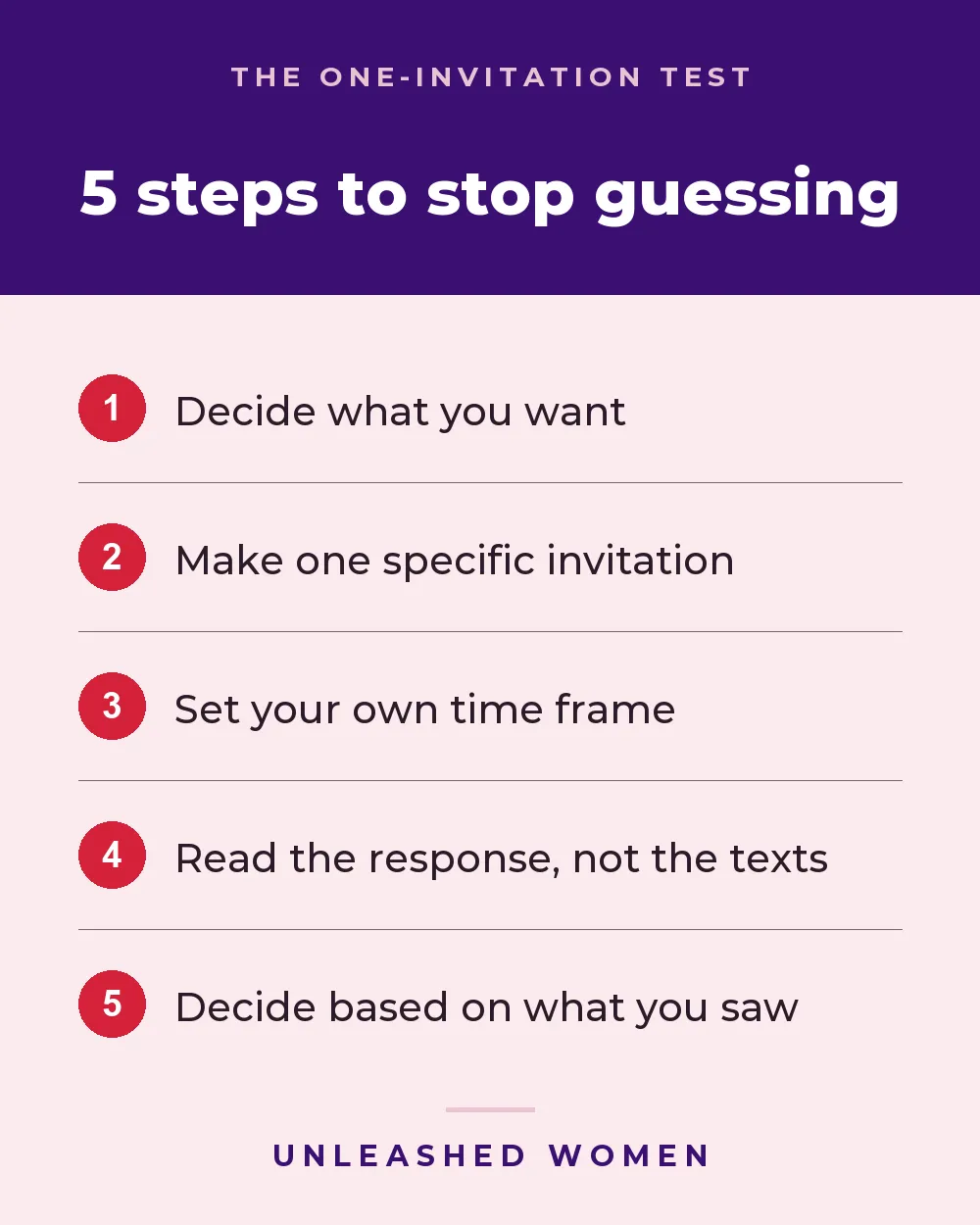
The one-invitation test
Rather than waiting indefinitely for him to suggest something, give the situation one clean, fair test.
This isn’t a trick or a power move.
It’s simply making it easy for him to say yes, so his response carries real information.
Step 1: Decide what you want. A date this week?
A phone call first?
Clarity about whether he’s looking for something serious?
Know your answer before you send anything.
Step 2: Make one specific invitation. Not “we should hang out,” but a day, a rough plan and an easy reply.
Specific invitations are easy to accept and hard to misread.
Step 3: Set your own time frame. One practitioner suggests deciding on a personal time frame for meeting in person; if it doesn’t happen within that window, your expectations probably aren’t aligned.
Two to three weeks after the invitation is a reasonable starting point, but choose what feels right to you.
Step 4: Read the response, not the texts around it.
- He says yes and helps make it happen (confirms a time, suggests a place). Great. Go, and see how it feels in person.
- He says yes but nothing gets confirmed. Ask once more for a specific day. If it stays vague, that’s your answer for now.
- He says no but offers another specific time. That’s real effort. Take him up on it.
- He dodges, changes the subject or goes quiet. You’ve learned something important, without having to guess.
Step 5: Decide based on what you saw. Not on his potential, his good-morning texts, or a story about what he must be feeling.
What to text: scripts you can use

These are written in your voice, calm and clear.
Adjust them so they sound like you.
The specific invitation:
“I’ve really enjoyed talking with you. I’d like to actually see you. Are you free for a drink Thursday or Saturday?”
When he says “definitely!” but nothing happens:
“Still up for getting together? Does Saturday at 7 work, or is another day better?”
The direct question (after a few weeks of texting with no plans):
“I like our conversations, and I’m looking to date someone I actually spend time with. Is meeting up something you want too? Totally okay if not, I’d just rather know.”
Stepping back kindly:
“I’ve enjoyed chatting, but I’m looking for something with more in-person time. I’m going to step back. Take care.”
Guidance from love is respect suggests describing what you want in clear, specific language.
It also reminds readers that wanting your needs met isn’t selfish, and that the other person is still free to say no. A clear “no” is disappointing, but it frees up energy that endless guessing would have used.
Mistakes that keep you stuck
Waiting with no end date. Without a time frame, “maybe next week” can stretch into months.
Over-decoding single messages. A long, sweet text at midnight is pleasant, but it isn’t a plan.
Look at the pattern over a few weeks, not at individual messages.
Matching his vagueness. Hinting (“I’m so bored this weekend…”) puts you back in guessing mode.
Ask directly instead.
Using silence as a strategy. Pulling back to “make him chase” turns your needs into a game.
Stepping back is fine when it’s a genuine decision about what you want, not a test he’s supposed to pass.
Ignoring how you feel. Psychology Today notes that people on the receiving end of this pattern often feel confused, anxious, self-doubting or on an emotional roller coaster.
Those feelings are worth taking seriously, whatever his reasons.
A quick self-check
Use this to look at the situation from your side.
It isn’t a test of him.
- I know what I want from this (a date, a relationship, something casual).
- I’ve made at least one specific invitation or asked one direct question.
- I’ve given myself a time frame and I’m honoring it.
- I feel more good than anxious after we text.
- I’m still open to meeting other people if this doesn’t move forward.
- I’m not turning down plans with friends to stay available for his texts.
If several boxes are unchecked, that’s not a failure.
It’s useful information about what to adjust.
A preliminary study of adults in Spain found that people who reported being repeatedly breadcrumbed also reported lower life satisfaction and more loneliness and helplessness.
The study can’t show that one caused the other, but it’s a good reason to protect your wellbeing instead of waiting it out.
Frequently Asked Questions
Should I be the one to ask him out?
You can, and it’s often the fastest way to get clarity.
One specific invitation is not chasing.
It’s giving the connection a fair chance to move offline.
If he accepts and helps make it happen, good.
If he dodges or stays vague after you’ve asked clearly, you have useful information, and you don’t need to keep asking.
How long should I wait for him to make plans?
There’s no universal rule, so set your own time frame.
As a starting point, you might give it two to three weeks after a clear invitation; that’s usually long enough to see whether anything gets scheduled.
What matters is choosing a limit in advance and honoring it, so the decision isn’t left to how hopeful or anxious you feel on a given day.
Is he just shy, or is he not interested?
From texts alone, you can’t tell, and neither can anyone else.
Shyness, a busy schedule, mixed feelings and lower interest can all look identical in a chat window.
A clear, low-pressure invitation tends to separate them: a shy person who wants to see you will usually accept a specific, easy plan, even if they wouldn’t have suggested it themselves.
Is this breadcrumbing?
It might fit the description.
Psychology Today describes breadcrumbing as small, occasional bits of contact without movement toward an actual relationship, such as texting without ever agreeing to meet.
But it’s a casual label, not a diagnosis, and it isn’t always intentional.
Rather than deciding what to call him, focus on what’s happening and whether it works for you.
Disclaimer: This article is general educational information about dating and relationships. It is not therapy, counseling, medical advice or legal advice, and it cannot tell you what another person thinks or guarantee any outcome. If you feel unsafe, contact local emergency services or the National Domestic Violence Hotline (1-800-799-7233).
Sources
- How to Turn a 'Textationship' Into Something More Meaningful — Psychology Today (Mark Travers, Ph.D. — Social Instincts blog)
- Breadcrumbing — Psychology Today (Basics topic page, reviewed by Gary Drevitch, Aug 2026)
- Psychological Correlates of Ghosting and Breadcrumbing Experiences: A Preliminary Study among Adults — International Journal of Environmental Research and Public Health (Navarro, Larrañaga, Yubero & Víllora, 2020) via PubMed Central, NIH
- What is toxic 'breadcrumbing'? Experts share signs and how to address it — CNN Health (Kristen Rogers, Dec 2023), quoting psychotherapist Duygu Balan, clinical psychologist Dr. Monica Vermani and psychology professor Dr. Kelly Campbell
- Long-distance texting: Text messaging is linked with higher relationship satisfaction in long-distance relationships — Journal of Social and Personal Relationships (Holtzman, Kushlev, Wozny & Godard, 2021) via PubMed Central, NIH
- It's Complicated: Our Relationship With Texting — American Psychological Association (press release, 2018)
- Get what you want and need from your relationship — love is respect (National Domestic Violence Hotline project)