Mixed signals from a guy usually mean there is a gap between what he says and what he does: warm texts but no plans, a great date followed by days of quiet, “I really like you” without much follow-through.
You cannot know from the outside what he is thinking or why.
What you can know is the pattern of his behavior, how that pattern affects you, and what you need in order to feel settled.
That is enough to make a clear decision — without decoding every message or waiting for certainty that may never come.
What mixed signals from a guy usually look like
“Mixed signals” covers a lot of situations, but most of them fall into a handful of patterns that therapists who write about modern dating describe again and again.
Licensed clinical social worker Leah Aguirre groups them roughly like this:
- Minimal but not zero effort. He replies, sometimes even starts conversations, but rarely suggests seeing you and doesn’t ask much about your life.
- Lack of follow-through. “Let’s do something this weekend” turns into silence, or plans get made and then cancelled without a new date offered.
- Hot and cold. An intense week of texting and a great date, then a stretch of short replies or nothing at all.
- Vague about what he wants. He seems interested but changes the subject when the future, exclusivity or even next week comes up.
- Talk without matching action. Lots of compliments and “we should” statements, very little time actually spent together.
Notice that every item on that list is something you can observe: messages, plans, dates, questions asked or not asked.
That matters, because observable behavior is the only solid ground you have.
Aguirre’s view is that when these patterns persist, they stop being “mixed” and start being information — and that you shouldn’t have to chase someone to get their time.
Signals that are often over-read
Not every inconsistency is a message.
Marriage and family therapist John Kim makes the opposite point in his list of common mixed signals: a lot of confusion comes from small, ambiguous changes that we fill in with our own fears.
Examples that frequently have ordinary explanations:
- He went from replying in minutes to replying in a few hours.
- He didn’t try to kiss you on a first date (the setting, his pace, or nerves can all play a role).
- He’s not big on affection in public.
- He wanted to wait a day before talking through something tense.
Texting is a special trap.
Research presented at the American Psychological Association’s convention found that among young adults in relationships, people who saw their partner’s texting style as similar to their own reported higher satisfaction — and that how couples texted mattered more than how often.
In other words, a difference in texting style can feel like a difference in interest even when it isn’t one.
The useful distinction is between a fluctuation (a slower day, a shorter reply) and a sustained shift (days of silence, plans that stop appearing, interest that only shows up when you pull back).
Fluctuations deserve patience.
Sustained shifts deserve your attention.
Evidence, interpretations and unknowns
The fastest way out of the overthinking loop is to sort what you’re holding into three piles.
Evidence is what happened.
Interpretations are possible meanings.
Unknowns are things you can’t find out by analyzing harder.
| Evidence (what you observed) | Possible interpretations | Unknowns |
|---|---|---|
| He texts most days but hasn’t suggested a date in three weeks. | He may enjoy the conversation but not be ready to invest more time; he may be busy; he may be less interested than you are. | Which of these is true, and whether it will change. |
| He said “I’d love to see you Saturday” and then didn’t confirm. | He may have forgotten, double-booked, or felt less sure than his words suggested. | What happened on his end unless he tells you. |
| He’s very warm in person and quiet between dates. | He may simply not enjoy texting; he may compartmentalize; he may be seeing other people. | His texting habits with others; whether you’re exclusive (unless you’ve discussed it). |
| He changes the subject when you mention next month. | He may be undecided, cautious, or not looking for something serious. | What he is actually looking for — until you ask directly. |
Seeing it laid out this way usually shows two things.
First, most of the anxiety lives in the right-hand column, which no amount of rereading will fill.
Second, the left-hand column often already tells you what you need to decide — not what he feels, but what this connection is currently giving you.
Why mixed signals are so hard to stop thinking about

If you find yourself rereading a conversation for the fourth time, you are not being dramatic.
Relationship researchers call this territory relational uncertainty: how confident you feel about involvement in a relationship.
It comes from three places — doubts about your own feelings, doubts about his involvement, and doubts about what the relationship even is.
In a pair of lab studies with dating couples published in Personal Relationships, people who felt more uncertain about their partner showed a bigger physiological stress response (measured through the stress hormone cortisol) during a hurtful conversation, and recovered more slowly after a supportive one.
These were small, correlational studies, so they don’t prove that uncertainty causes stress.
But they fit what many women describe: when you can’t predict someone, your body stays on alert.
That is a useful reframe.
The exhaustion you feel may be a predictable response to not knowing where you stand — not a sign that you’re “too much.”
It also explains why trying to resolve the uncertainty by analyzing harder rarely works.
The relief usually comes from changing the situation: getting more information, or deciding you don’t need to wait for it.
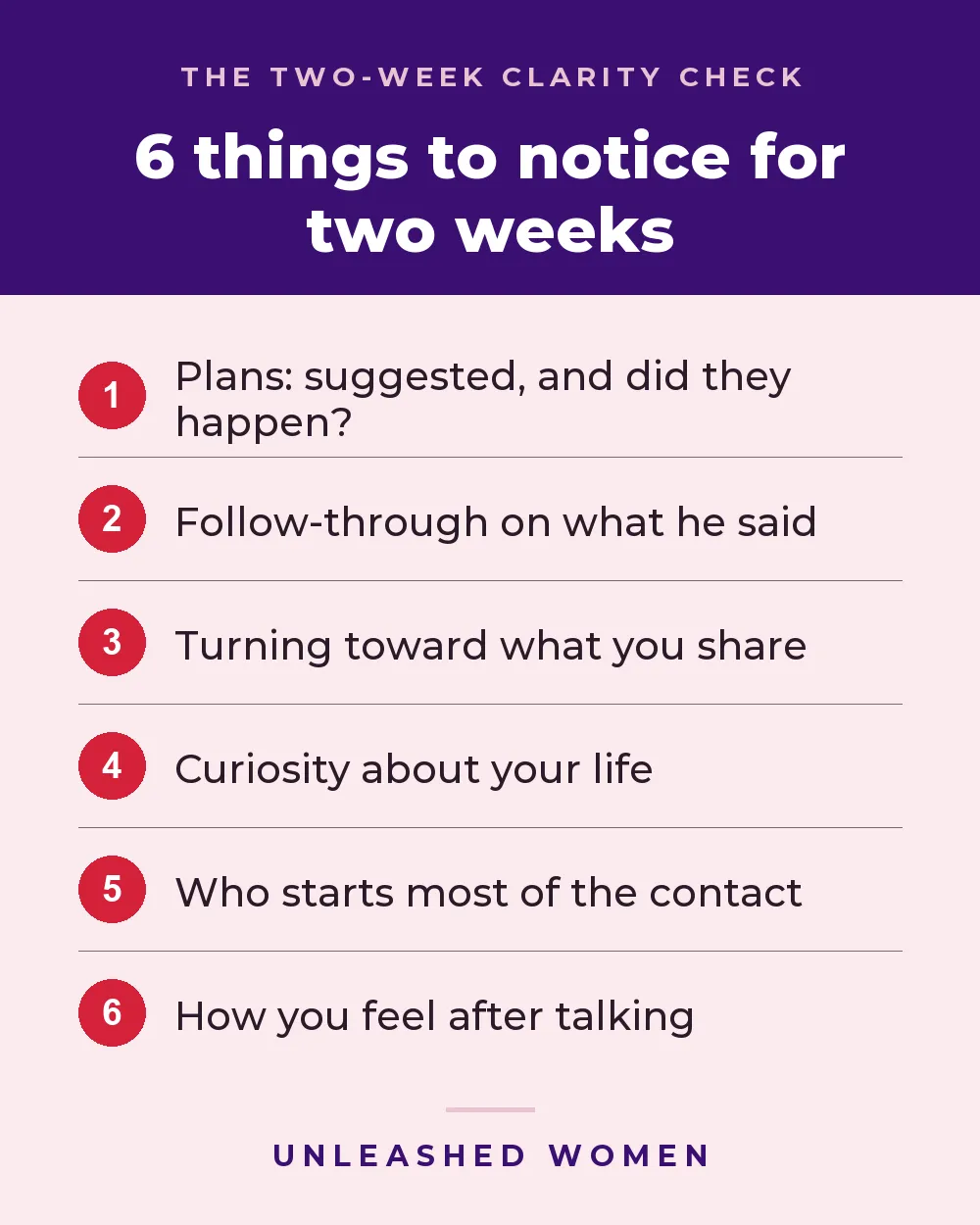
The two-week clarity check
Instead of interpreting each message on its own, look at a short window of behavior as a whole.
For the next two weeks, notice — don’t analyze — the following.
Use this checklist as a framework, not a scorecard.
- Plans: Did he suggest a specific time to see you, and did it happen?
- Follow-through: When he said he’d do something (call, confirm, show up), did he?
- Turning toward: When you shared something — a bad day, good news, a funny moment — did he respond to it with interest?
- Curiosity: Does he ask about your life, or mostly talk about his?
- Initiation: Who starts most of the contact? Would it continue if you stopped?
- Your body: After talking to him, do you generally feel calmer or more unsettled?
The “turning toward” item comes from the Gottman Institute’s work on bids for connection — small attempts to get attention or affection.
In John Gottman’s research with newlyweds, couples who were still together six years later had responded to each other’s bids far more often than couples who divorced.
That research was with married couples, so treat it as a lens rather than a rule for early dating.
But responsiveness is something you can actually see, which makes it more useful than guessing at feelings.
At the end of two weeks, you’ll likely have one of three pictures: a mostly consistent pattern with a few off days, a clearly low-effort pattern, or a genuinely mixed picture.
Only the third needs a conversation to clarify.
What to say: scripts for asking clearly
When the picture is genuinely mixed, the most efficient move is a short, direct question.
The nonprofit love is respect recommends a structure from dialectical behavior therapy called DEAR MAN: describe the situation, express how you feel, assert what you want, reinforce why it matters, stay mindful of your point, appear confident, and be willing to negotiate.
You don’t need all seven steps in a text.
A light version works well in early dating:
If plans keep falling through: “I’ve really enjoyed the times we’ve hung out.
I’ve noticed plans have been hard to pin down lately, and I’m someone who likes knowing when I’ll see the person I’m dating.
Want to pick a night this week?”
If you’re unsure what this is: “I’m enjoying getting to know you.
I’m dating with a relationship in mind, and I’d love to know what you’re looking for right now — no pressure either way, I’d just rather know.”
If the hot-and-cold pattern is wearing on you: “When we’re together it feels great, and then I don’t hear much for days.
I’m not asking for constant texting, but I do want more consistency than this.
Is that something you’re up for?”
Two important caveats.
First, as love is respect notes, communicating well doesn’t mean you’ll get the answer you want; the other person still gets to choose.
The goal of the script is clarity, not persuasion.
Second, his response is new evidence.
Pay attention to what changes in the following week, not only to what he says in the moment.
When to walk away

A simple decision tree can help when you’re stuck:
- Is anything about this frightening, controlling, or monitoring you? If yes, prioritize your safety (see below) — this is beyond mixed signals.
- Have you observed a sustained pattern, not just a slow day or two? If no, give it the two-week check before deciding.
- Have you asked clearly what he wants or what you need? If no, consider using one of the scripts above.
- After asking, did his behavior change in a way you can see? If yes, keep observing with fresh eyes. If no, the pattern is your answer for now.
- Does the connection, as it currently is, give you what you want? If yes, enjoy it on those terms. If no, you’re allowed to step away — you don’t need to know his reasons to make a decision about your time.
Aguirre puts the last point plainly: some people are fine with something casual and unpredictable, and that’s a legitimate choice.
But if you’re constantly reading between the lines and it’s costing you sleep and peace, that cost is worth taking seriously on its own.
A safety note: confusing behavior is different from behavior that frightens or controls you — monitoring your phone, threatening, isolating you from friends, or punishing you with silence when you set a boundary. love is respect advises against confronting a partner who is abusive.
If anything here feels unsafe, you can reach the National Domestic Violence Hotline at 1-800-799-7233, and talking with a licensed therapist can help you sort through any relationship that’s leaving you anxious.
Frequently Asked Questions
Is he losing interest if he texts less than he used to?
Not necessarily.
Early texting often starts high and settles down, and texting style varies a lot between people.
A drop that comes with fewer plans, less curiosity about you and missed follow-through is more meaningful than lower message volume alone.
Look at the whole pattern over a couple of weeks.
How long should I wait for mixed signals to become clear?
There’s no research-based number.
A practical approach is to observe for about two weeks, then ask one clear question, then watch for another week or two.
If nothing you can observe changes after you’ve asked, waiting longer usually produces more uncertainty rather than more clarity.
Should I just match his energy?
Matching his effort can be a helpful way to stop over-investing and see what he does on his own.
Just be honest with yourself about the goal: if it’s to protect your time, great; if it’s a test to make him chase you, it tends to add more games and more guessing.
Can I ask what we are without scaring him off?
You can ask in a calm, low-pressure way, like the scripts above.
If a simple, kind question about what he’s looking for ends things, that tells you something useful about compatibility — it isn’t a sign that you asked wrong.
Disclaimer: This article is general educational information about dating and relationships. It is not therapy, counseling, medical advice or legal advice, and it cannot tell you what another person thinks or guarantee any outcome. If you feel unsafe, contact local emergency services or the National Domestic Violence Hotline (1-800-799-7233).
Sources
- 5 “Mixed Signals” That Are in Fact Signals — Psychology Today (Leah Aguirre, LCSW — Modern Dating blog)
- 7 Common Mixed Signals in Dating and Relationships — Psychology Today (John Kim, LMFT — The Angry Therapist blog)
- Relational Uncertainty and Cortisol Responses to Hurtful and Supportive Messages from a Dating Partner — Personal Relationships (Priem & Solomon, 2011) via PubMed Central, NIH
- Turn Towards Instead of Away — The Gottman Institute (Zach Brittle, LMHC)
- Get what you want and need from your relationship — love is respect (National Domestic Violence Hotline project)
- It's Complicated: Our Relationship With Texting — American Psychological Association (press release, 2018)