The clearest sign a situationship is going nowhere is not a single cancelled plan or a slow reply.
It is a lack of movement over time: months later, you spend the same kind of time together, you still are not part of each other’s wider lives, nobody talks about what comes next, and nothing changes after you say what you want.
You cannot know why he is not moving things forward.
But you can notice whether anything is moving, ask one clear question, and decide based on what you want.
What “going nowhere” actually looks like
Researchers who study situationships describe them as romantic connections with no clear label and low commitment, even though the two people spend time together and are affectionate and sexual much like an established couple.
That mix is exactly why it is confusing: it can feel like a relationship while not functioning as one.
A psychologist writing for Cleveland Clinic lists the features that tend to show up.
Translated into things you can actually see, a stalled situationship often looks like this:
- The future never comes up. You have been seeing each other for months and neither of you has said what you want long term. If you bring it up, the subject changes or gets a joke.
- Plans stay short-range. He’ll suggest Friday night, but not a wedding next month, a trip or a holiday.
- Your lives stay separate. You have not met his friends or family, he has not met yours, and you are not mentioned or tagged anywhere.
- Contact is on his schedule. He reaches out late, or when other plans fall through, and goes quiet for days in between.
- Conversations stay on the surface. You talk a lot, but rarely about feelings, values or what this is.
- Nothing grows and nothing ends. The connection stays just good enough to continue, but it does not deepen.
- You keep things light out of fear. You stay quiet about what you want because you worry asking will end it.
None of these alone proves anything.
A pattern of several, lasting months, is information worth taking seriously.
Slow vs. stuck: how to tell the difference
Some connections start casually and become relationships.
So the question is not “is this a situationship?” but “is it going anywhere?”
A simple test: compare now to three months ago.
| Slow but moving | Stuck |
|---|---|
| You talk a bit more openly than you used to | Conversations are the same depth they were at the start |
| You have met at least some of his people, or plans to | You still exist in a separate bubble |
| Plans are stretching further ahead | Plans are still same-week or last-minute |
| When you raised what you want, something shifted | You raised it and nothing changed |
| You feel steadier over time | You feel more anxious or second-guessing over time |
In an Australian interview study, young adults described progression as needing three things: emotional availability, real communication and commitment from both people.
If none of those has appeared over a long stretch, “slow” is probably not the right word for what is happening.
Evidence, interpretation and unknowns
When you are anxious, it is easy to blur what happened with what you fear it means.
Separating them helps.
| What it includes | Example | |
|---|---|---|
| Evidence (what you can observe) | Actions, words and patterns over time | “We’ve been seeing each other for five months. He hasn’t introduced me to anyone. When I asked what we are, he said he doesn’t like labels.” |
| Interpretation (what it might mean) | Possible explanations, clearly labeled as possible | He may want something casual. He may be unsure. He may be dealing with something he has not shared. He may want more but not right now. |
| Unknowns (what you can’t know from the outside) | His inner thoughts, motives and other relationships | Why he hasn’t moved forward, whether he is seeing other people (unless you’ve discussed it), whether a conversation would change anything. |
Notice that every interpretation leads to the same practical point: the connection, as it is, is not giving you commitment.
You do not have to solve why to decide whether it works for you.
Why it’s so hard to walk away
If the signs are clear, why stay?
Research gives some honest answers, and none of them mean something is wrong with you.
Hope. In a study of college students in situationships, many said they stayed because they hoped it would become a real relationship; the lead researcher described it as a kind of waiting room.
People in that study felt more satisfied when the two of them talked about the future and when they felt prioritized.
(The sample was mostly young women in college, and the data were a single snapshot, so treat this as a pattern, not a rule.)
What you’ve already put in. The sunk cost fallacy is staying with something because of the time and feeling you have already invested, not because it is still the best choice.
Months of emotional effort can make leaving feel like wasting them.
It does give you something. Situationships can provide companionship, intimacy and support.
But a relationship researcher at Florida State University notes that research finds them less satisfying than more committed relationships, and that the ambiguity is associated with hypervigilance, lower self-esteem and poorer well-being.
The pain feels like it doesn’t count. People in the Australian study described real heartache that others dismissed because it was “not a real relationship.”
Your feelings are valid whether or not there was a label.
The clarity conversation: what to say

Months of reading hints rarely produce an answer.
One calm, direct question usually does, even if the answer is vague.
The guidance from loveisrespect is to describe what you want clearly and calmly, without pressure, guilt or ultimatums.
Pick a relaxed moment, ideally in person.
To open the conversation:
“I’ve really liked spending time with you. I’ve realized I’m looking for something committed, and I’d like to know where you see this going.”
If he says he doesn’t like labels:
“That’s fair, and I’m not asking for a word. I’m asking whether you see us building toward a relationship, because that’s what I want.”
If he says he’s not sure:
“Thanks for being honest. Take some time. I’d like to talk again in a couple of weeks, because I don’t want to stay in the in-between much longer.”
If he says he wants to keep it casual:
“I appreciate you telling me. That’s not what I want, so I’m going to step back.”
These are not tests or tactics.
You are sharing what you want and asking what he wants.
His answer, and what he does afterward, is the information you need.
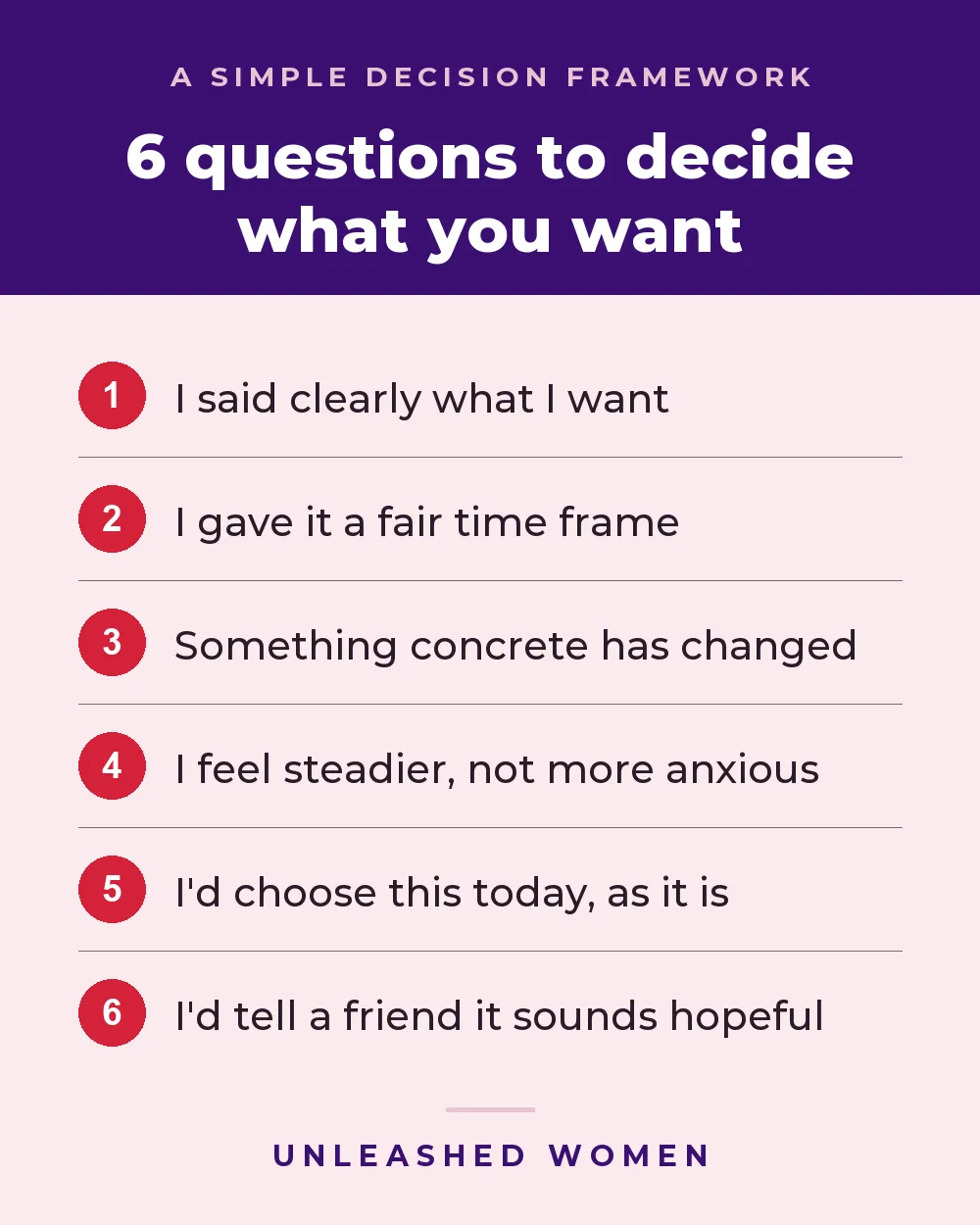
A simple decision framework
Use this checklist after you have had the conversation, or if you are still deciding whether to have it.
- I have said clearly what I want (not hinted).
- I have given it a reasonable personal time frame (for example, four to six weeks after the conversation).
- Since then, something concrete has changed: future plans, meeting his people, deeper conversations, more consistency.
- I feel steadier in this connection, not more anxious.
- I would choose this connection today, as it is, even if I had not already invested months in it.
- If a friend described this exact situation to me, I would tell her it sounds hopeful.
Mostly checked: something may be moving.
Keep talking openly and keep checking in with yourself.
Mostly unchecked, especially the last two: the connection is telling you what it is right now.
Staying is still your choice, but make it knowingly, not while waiting for a change that has not come.
The “would I choose this today” and “what would I tell a friend” questions come from Cleveland Clinic’s guidance on getting past the sunk cost trap.
They help you look at the connection as it is now, not as it might someday be.
If you decide to end it

Situationships often fade out rather than end, which can leave you without closure.
The Cleveland Clinic psychologist recommends saying clearly that it’s over instead of disappearing, and then giving yourself room: fewer late-night texts, and time to reflect on what you learned and want next time.
A short message is enough:
“I’ve realized I want a committed relationship, and I don’t think this is going to become that. I’ve enjoyed our time together, and I’m going to step away now. I wish you well.”
You do not owe a long explanation, and you do not need him to agree.
Frequently Asked Questions
How long is too long to stay in a situationship?
There is no research-backed number.
A more useful measure is movement: if several months have passed, you have said what you want, and nothing concrete has changed within the time frame you set, that is a clear answer about where things stand right now.
Can a situationship turn into a real relationship?
Sometimes.
Research suggests many people in situationships hope for exactly that.
In interviews, people linked progression to emotional availability, honest communication and commitment from both sides.
If those are showing up and growing, it may be moving.
If they are absent after you have asked, hoping harder usually does not change the pattern.
How do I ask where this is going without scaring him off?
Keep it calm, brief and about you: say what you want and ask what he wants.
You cannot control his reaction.
If a sincere, low-pressure question ends the connection, it was unlikely to give you what you were looking for anyway.
Why does it hurt so much when it wasn’t even official?
Because the closeness was real.
Researchers describe situationships as involving affection, intimacy and time together much like established couples, so losing one can feel like a breakup.
Your feelings make sense and deserve care, label or not.
Disclaimer: This article is general educational information about dating and relationships. It is not therapy, counseling, medical advice or legal advice, and it cannot tell you what another person thinks or guarantee any outcome. If you feel unsafe, contact local emergency services or the National Domestic Violence Hotline (1-800-799-7233).
Sources
- Defining and Describing Situationships: An Exploratory Investigation — Sexuality & Culture (Springer) — Langlais, Podberesky, Toohey & Lee, 2024
- New psychology research reveals why people stay in situationships — PsyPost (Eric W. Dolan), reporting Langlais et al., Sexuality & Culture, 2025
- All the Feels, None of the Labels: Young Adults' Experiences of Situationships — Societies (MDPI) — Anderson & Phillips, 2026
- It's complicated: FSU social psychologist discusses the rise in situationships — Florida State University News (Andrea Meltzer, Ph.D., Department of Psychology)
- Situationships: What They Are and 5 Signs You're in One — Cleveland Clinic Health Essentials (psychologist Susan Albers, PsyD)
- Sunk Cost Fallacy: Why We Stick With Bad Decisions — Cleveland Clinic Health Essentials (psychologist Susan Albers, PsyD)
- Get what you want and need from your relationship — loveisrespect (National Domestic Violence Hotline project)